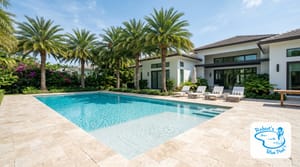
A homeowner in Coral Gables called us about acid. He was pouring a quart of muriatic into a 15,000-gallon pool every week, and the pH still read 8.0 by Saturday. Nothing was broken. The two sheer descents on his raised bond beam ran six hours a day, and every hour they ran, they pushed his pH up.
Your Waterfall Works Like a pH Pump
Carbon dioxide dissolved in pool water forms carbonic acid, and that acid holds pH down. Break the water into sheets, droplets, or bubbles and the CO2 leaves for the air. Less carbonic acid in the water means a higher pH reading on your test kit. Orenda Technologies calls this the carbonate equilibrium system, and it works the same way in a spa spillover, a bubbler, and a deck jet.
Aeration is the one common method of raising pH that leaves total alkalinity alone. Pool operators use it on purpose when they need to knock alkalinity down with acid and bring pH back afterward. Your waterfall does the same job on its own schedule.
Four conditions speed up the off-gassing: carbonate alkalinity above 80 ppm, a low starting pH, warm water, and strong circulation. A Miami pool in August sits at all four. That is why the acid demand you see in February looks nothing like the acid demand you see now, on the same pool, with the same feature.
The Water You Lose, and the Autofill That Hides It
A South Florida pool gives up about a quarter inch a day to evaporation. On 500 square feet of surface that runs near 25 gallons a day, close to 2,500 gallons a month. Start a feature and the number climbs. Moving water exposes more surface to air, and evaporation estimates for waterfalls and fountains land somewhere between 20 and 60 percent above a still pool, depending on the feature and how long it runs.
Humidity here works in your favor. NWS Miami logged average relative humidity at 78 percent on August 3 and 79 percent on August 24 of this year. High humidity slows evaporation. It does not stop it, and a sheer descent catching an afternoon sea breeze moves water fast.
Miami-Dade Water and Sewer charges $4.0995 per ccf between 4 and 17 ccf and $9.9162 per ccf at 18 ccf and over, with wastewater at $8.1673 per ccf on top of that. A few hundred extra gallons a month costs you a couple of dollars. The bill is not the issue. What rides in with the makeup water is.
An autofill valve makes this invisible. The water line never moves, so you never see the loss, and the pool keeps drinking hard tap water all summer. If you ever need to screen for a real leak, shut the autofill off first, or the fill valve will cover the drop and you will spend a month chasing a number that never falls. We walked through that math in what a slow pool leak really costs Miami homeowners.
Why Scale Lands on the Waterfall Face First
Biscayne Aquifer water is hard, and evaporation concentrates what it leaves behind. Pure H2O goes into the air. The calcium stays. Top off a pool all summer and calcium hardness climbs, which is the same problem we covered in calcium hardness in Miami pools. A feature accelerates the whole cycle because it evaporates more water per day than a still surface does.
Calcium dissolves worse as water heats up. A travertine spillway lip baking in July afternoon sun holds far less dissolved calcium than the 86-degree water in the pool below it. Thin film, hot stone, fast evaporation. The white crust on that lip is calcium carbonate, and it will keep coming back after every acid wash until the water balance changes.
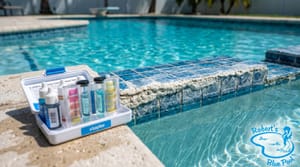
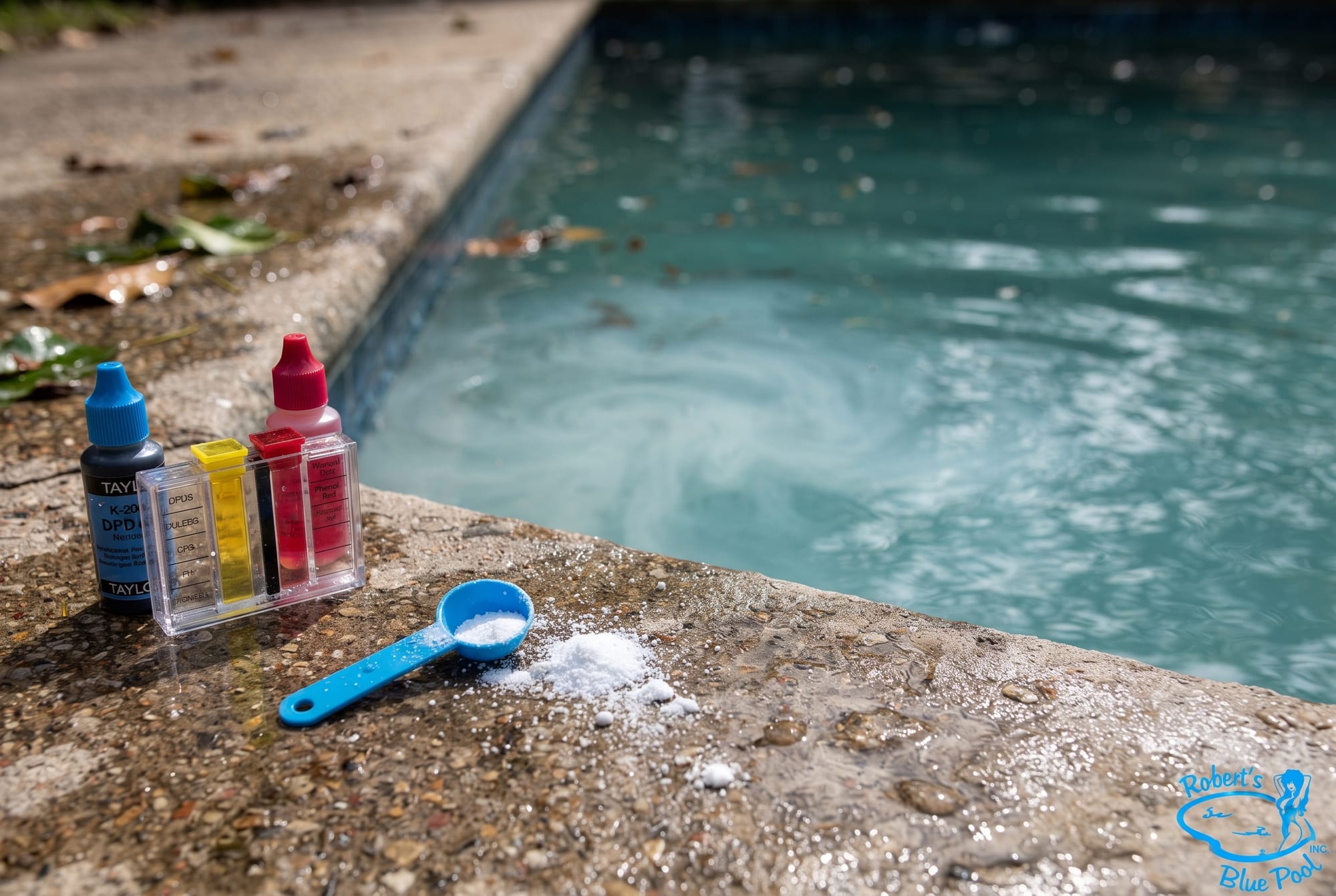
Rising pH makes it worse. The Pool & Hot Tub Alliance sets the acceptable range at 7.2 to 7.8 with an ideal band of 7.4 to 7.6, and a feature pool that drifts to 8.0 between service visits sits on the scaling side of the saturation index for days at a time. PHTA also notes that carbonate alkalinity, not raw total alkalinity, belongs in the LSI calculation, since cyanuric acid inflates the TA reading on a stabilized outdoor pool.
Put the Feature on Its Own Pump
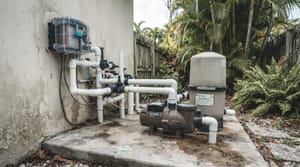
Plenty of Miami pools run the waterfall off the main pump through a diverter valve. That forces the filtration pump to a speed it never needs for filtering, and it erases the variable-speed savings for every hour the feature runs. Pentair rates the IntelliFlo3 VSF for water feature performance up to 170 gallons per minute at 25 feet of total dynamic head, in 1.5 and 3.0 horsepower, with programmable presets that separate a feature speed from a filtration speed.
A dedicated feature pump on its own schedule buys you two things: filtration at low RPM all day, and a real off switch for the aeration. Tie that switch to a panel and you can shut the feature down from your phone when the pH starts climbing. We compared the panels in pool automation in Miami. Miami-Dade requires an electrical permit for a new equipment circuit, so a second pump is a permitted job, not a weekend swap.
What to Change This Week
- Test pH twice a week, not once. A feature pool drifts between visits, and a Monday reading tells you nothing about Friday.
- Cut feature run time to the hours you are outside to enjoy it. Six hours of aeration for two hours of company is a bad trade.
- Hold total alkalinity near the bottom of the 60 to 180 ppm range PHTA allows. Around 80 ppm the pH drifts slower.
- Check calcium hardness at the start of every month through the summer instead of once a season.
- Acid wash the spillway lip only after you fix the balance, or you will be back on a ladder in six weeks.
None of this argues against water features. A sheet of water over travertine is the reason half of our clients built the pool they built. It costs a little more attention than a flat pool, and the owners who know that stay ahead of it. Robert's Blue Pools has serviced Miami-Dade pools since 2007, and we set feature schedules and acid dosing together instead of treating them as separate problems.
If your feature pool eats acid every week, call Robert's Blue Pools at (305) 762-7665 and we will put a schedule on it that holds.