

Your autofill valve is doing its job. That is the problem. It tops the pool off every night, the water line never moves, and the first sign anything is wrong arrives sixty days later on a Miami-Dade water bill that jumped by a hundred and fifty dollars.
A pool that drops an inch a day looks fine from the patio. On a standard 15 by 30 foot pool, that inch is 280 gallons. Evaporation in South Florida accounts for about a quarter inch, or 70 gallons. The other 210 gallons a day go into the ground under your deck.
What a Miami-Dade Water Bill Says About Your Pool
Miami-Dade Water and Sewer bills in ccf, and one ccf equals 748 gallons. Under the 2025-26 rate schedule in Implementing Order 4-110, effective October 1, 2025, residential water runs $4.0995 per ccf from 4 to 17 ccf and climbs to $9.9162 per ccf at 18 ccf and over. Wastewater adds $8.1673 per ccf on everything past the first 3 ccf.
Run those numbers on a 210 gallon per day leak. That is 6,300 gallons a month, or 8.4 ccf. For a household already past the 18 ccf threshold, the combined water and sewer cost of that leak lands near $152 a month. Two months of waiting costs more than a leak detection appointment, which runs $150 to $600 in Florida.
Above 18 ccf you also pick up the South Florida Water Management District restriction surcharge, which rises with whatever restriction phase the district has in force. SFWMD issued a water shortage warning for Miami-Dade and Monroe counties in February 2026 and rescinded it once the Biscayne Aquifer recovered. The surcharge stays on the rate sheet either way.
The Bucket Test Takes One Day
Shut the autofill off. Fill a five gallon bucket and set it on the second step so the water inside the bucket sits level with the pool. Mark both levels with painter's tape. Leave the pump on its normal schedule. Check after 24 hours.
If the pool dropped more than the bucket, water is leaving through something other than the sky. Run it a second time with the pump off. A bigger drop with the pump running points at the pressure side plumbing. An equal drop either way points at the shell, the skimmer throat, or a light niche. That one distinction saves a technician an hour of guessing, and it shows up on your invoice. Our breakdown of how pros find leaks you cannot see covers what happens after the bucket.
Your Pool Chemistry Pays Before Your Deck Does
Every gallon the autofill adds is Biscayne Aquifer water. Miami-Dade pulls roughly 330 million gallons a day from that aquifer through wells averaging 80 feet deep, and the USGS describes it as hard, calcium bicarbonate water. Replacing 6,300 gallons a month means adding calcium hardness at that same rate while diluting your stabilizer and your chlorine.
You see it as scale creeping across the tile band, water that clouds after every rain, a salt cell reading low, and a chlorine demand that keeps climbing. Owners chase those symptoms with buckets of chemicals for months. The chemicals are treating a plumbing problem. A technician on a weekly maintenance route catches the pattern because he sees the same pool every seven days.
What the Water Does Under Your Deck
Miami-Dade sits on sand over limestone with a water table three to six feet down across much of the county. Water leaving a cracked return line does not puddle. It moves through that sub-base and carries the fines with it. Six months of that hollows out a void, and the void announces itself as a settled paver, a coping stone separated from the bond beam, or a hairline crack in the deck that opens a little wider each rainy season.
At that point you are no longer paying for a pipe repair. You are paying for demolition, void fill, coping reset, and tile. The same leak found in August is a plumbing job. Found next spring, it is a renovation. Our pool repair crew has dug up plenty of the second kind, and every one of them started as the first kind.
Signs Worth a Phone Call This Week
- The pool drops more than a half inch a day with the autofill valve closed
- Your water bill climbed and nothing about your household changed
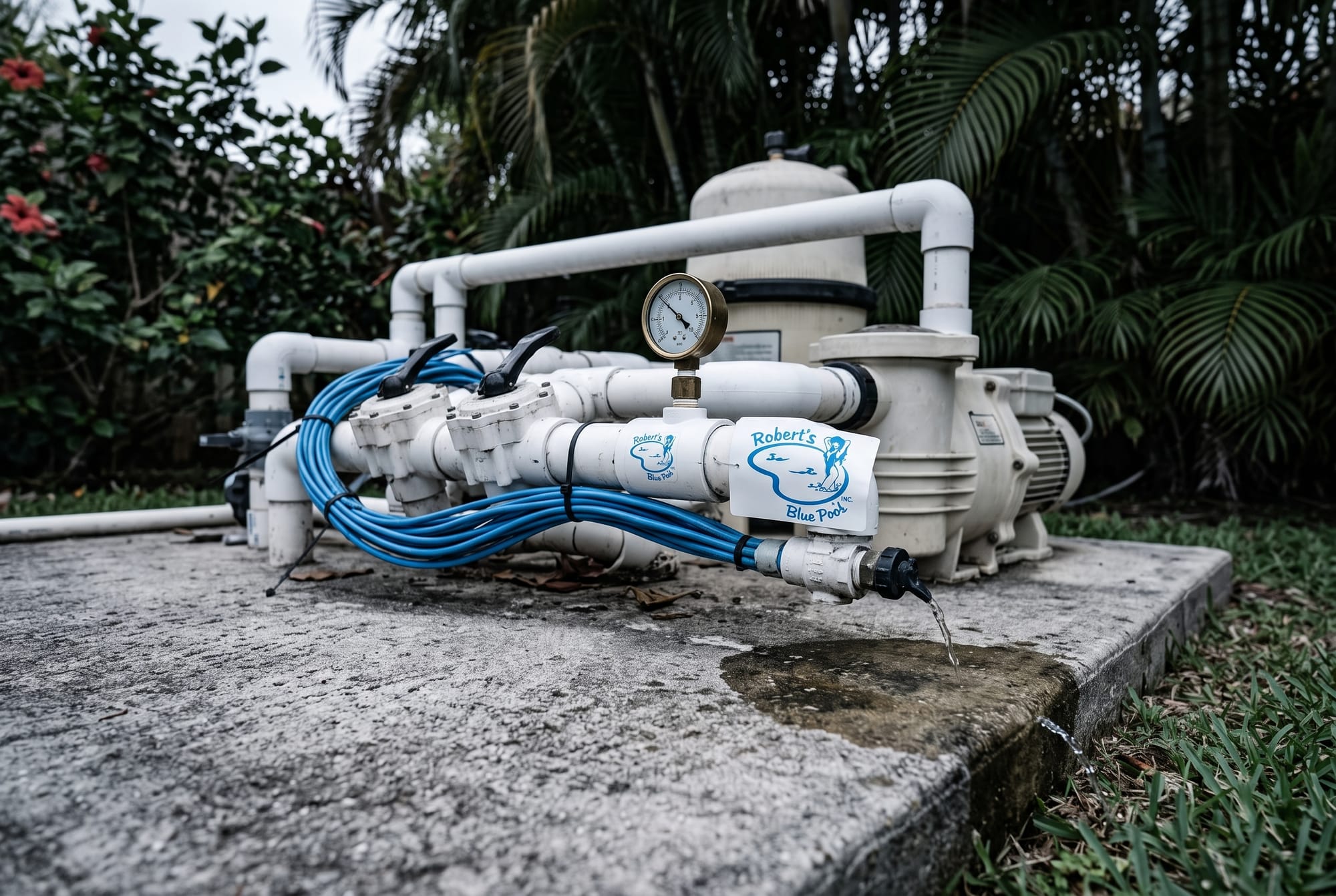
- The deck or grass near the equipment pad stays wet through a dry week
- Air bubbles come out of a return jet with the pump primed and the basket full
- Cracks in the deck near the pool edge widened since last summer
Fix It While It Is Still a Plumbing Job
Robert's Blue Pools has run leak diagnostics across Miami-Dade since 2007, from Coconut Grove to Key Biscayne. We pressure test each line, dye test the shell and the fittings, and hand you a location before anyone breaks concrete. Most of the leaks we find cost less to repair than the water the homeowner already lost finding out.
A leak costing you $152 a month in water is worth one afternoon of diagnosis, so call Robert's Blue Pools at (305) 762-7665 and we will find it before your deck does.