Your salt cell quit making enough chlorine, so you pulled it out and looked inside. The plates wear a white crust. That crust is calcium, and in Miami it builds faster than in almost any market in the country.
Hard water here is a Biscayne Aquifer problem before it ever becomes a pool problem. Miami-Dade draws its drinking water from that aquifer, and the aquifer sits inside porous limestone. Limestone is calcium carbonate. Rain soaks through the rock, dissolves the calcium, and carries it to your tap. By the time you top off a pool, the water already holds a load of calcium. The Miami-Dade Water and Sewer Department reports hardness in its annual Water Quality Report, and local readings run from about 150 mg/L on the soft end up toward 200 ppm, which the water industry files under “very hard.”
What calcium hardness is and where it belongs
Calcium hardness measures the dissolved calcium in your water, counted in parts per million. The Pool & Hot Tub Alliance and Taylor Technologies put the working range for a plaster or concrete pool at 200 to 400 ppm, and most service techs aim for 250 to 350 ppm. Vinyl and fiberglass pools sit a notch lower.
The range matters in both directions. Drop below 200 ppm and the water turns aggressive. It goes looking for calcium and pulls it straight out of your plaster, which shows up as etching and a rough, chalky surface. That kind of damage shortens the life of a finish and pushes you toward resurfacing sooner than you planned. Climb past 400 ppm and the water swings the other way. Now it carries more calcium than it can hold, so the excess drops out as scale on tile, in plumbing, and on every hot surface in your equipment pad.
Why Miami numbers climb on their own
Two forces stack up here. Your fill water starts high, then the sun goes to work. Calcium does not evaporate. Water does. Every gallon that leaves the surface as vapor leaves its calcium in the pool. South Florida runs high evaporation 12 months a year, so the calcium concentrates with every hot afternoon. A pool that tested 300 ppm in March can read 450 by late August without anyone adding a thing.
Heat works a second angle too. Calcium dissolves better in cool water than in hot. As your pool warms into the upper 80s through summer, water holds calcium less willingly, and the odds of scale go up.
The LSI ties it all together
One number connects the pieces: the Langelier Saturation Index. Orenda and other water chemists use the LSI to read the balance of five things at once, including pH, total alkalinity, calcium hardness, water temperature, and total dissolved solids. A positive LSI means the water trends toward scaling. A negative LSI means it trends toward corrosion and plaster etching.
Temperature lives inside that formula, and that is the part Miami owners miss. The same chemistry that reads balanced at 78°F can read scaling at 88°F. Your pool does not stay 78°F here in July. So a number that looked fine in spring can tip toward scale by mid-summer on temperature alone.
What hard water costs you at the equipment pad
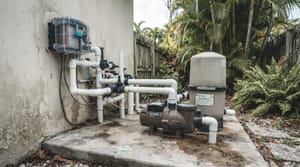
Your heater takes the first hit. A heat exchanger runs its metal surfaces at 140 to 180°F, far hotter than the pool. Calcium that stays dissolved at swimming temperature precipitates onto that hot metal and bonds there. A thin scale layer insulates the coil and cuts heat transfer by 20 to 30 percent, so the heater burns more gas or pulls more power to reach the same temperature. Worse, scale creates hot spots where heat cannot pass through, and those spots crack the metal over time.
Salt cells scale for the same reason, with an extra push. The electrolysis that makes chlorine raises pH and heat right at the plates, which is the ideal setup for calcium to deposit. Once the plates crust over, chlorine output drops and the cell ages out early. You can acid-clean a cell, but every cleaning strips a little of the plate coating, so chronic high calcium means a shorter cell life and a bigger replacement bill. If you run a saltwater system, this is one more reason to watch your hardness closely, a point worth weighing against the rest of the salt versus chlorine tradeoffs in our climate.
How to bring hard water back in line
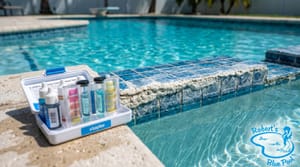
Start with a real test. Strips give you a ballpark, but a drop-count calcium test from a kit like Taylor reads close to lab grade, and that accuracy matters when you are deciding whether to drain.
If your hardness has climbed too high, the fix is dilution. Drain 25 to 50 percent of the pool and refill with fresh water. The math is simple: multiply your current hardness by the water you keep, add your tap hardness times the water you add, then divide by the full volume. A pool sitting at 600 ppm, refilled by half with 150 ppm tap water, lands near 375 ppm. If you want to skip the drain, some Miami pool owners hire a mobile reverse osmosis service that filters the existing water down to low hardness without dumping it, which costs more but saves the fill.
Low hardness calls for the opposite move. Add calcium chloride to bring the number back into range and stop the water from eating your plaster.
The cleanest path through all of this is steady testing instead of one big correction after the damage shows. A weekly check catches hardness while it is drifting, not after it has scaled your heater. That is the core of what our weekly maintenance plans handle for Miami-Dade owners, and it is the difference between adjusting a number and replacing a salt cell.
If your tile is graying, your heater is working harder than it used to, or your salt cell keeps crusting over, call Robert’s Blue Pools at (305) 762-7665 and we will test your hardness and tell you exactly where you stand.