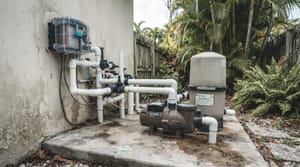
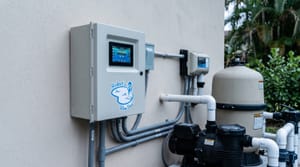
A tropical wave parks over Kendall on a Thursday afternoon and dumps two inches on your pool. Your filter pump shuts off at 3 p.m. because a mechanical time clock says it shuts off at 3 p.m. You get home at seven to cloudy water and a skimmer basket packed with sea grape leaves. Pool automation closes the gap between what your pool needs and what you programmed into it last spring. The question is whether closing that gap costs less than living with it.
What a pool automation panel controls
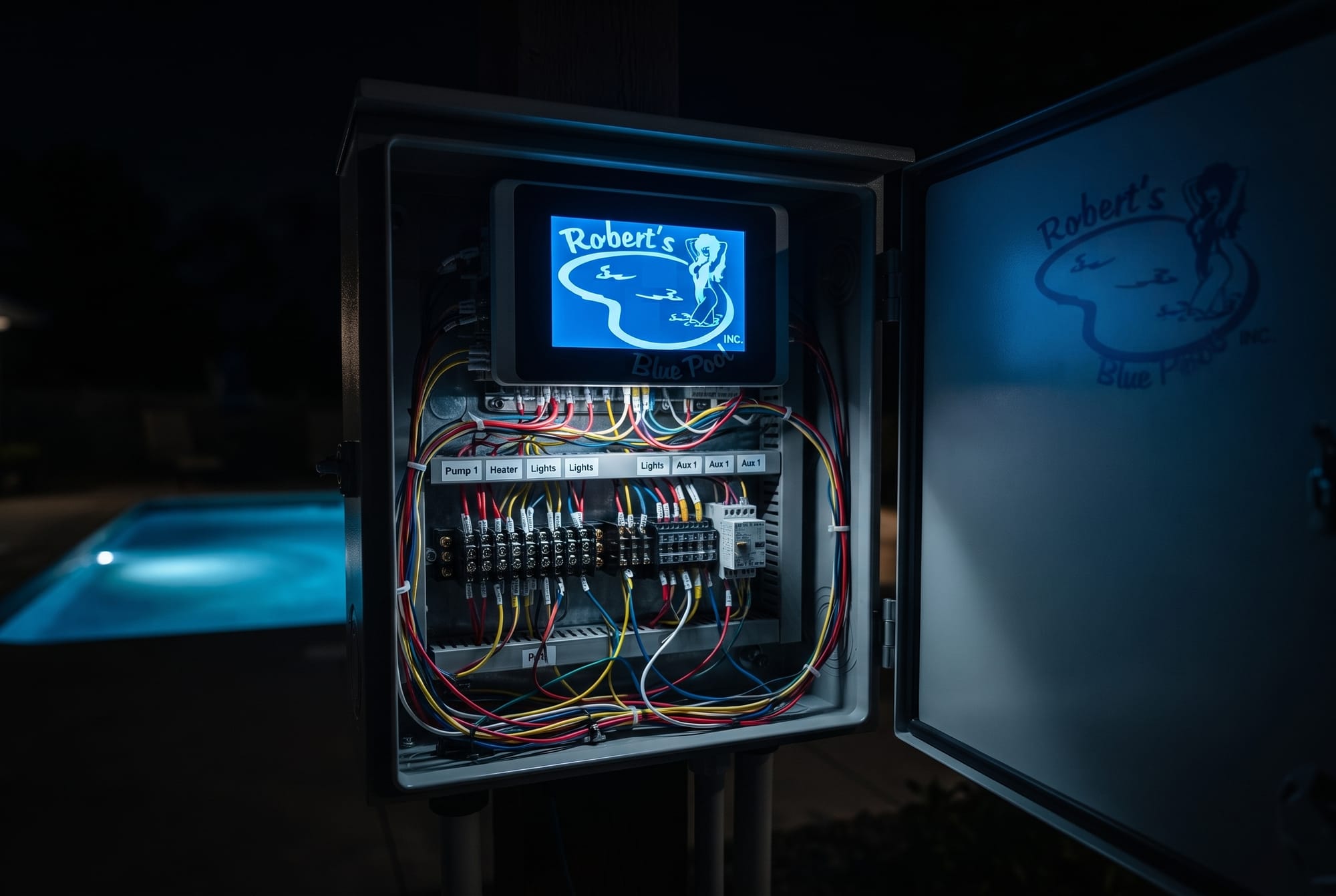
An automation system is a relay box with a brain. It switches high-voltage circuits, drives valve actuators, reads temperature sensors, talks to your variable-speed pump over a data cable, and takes orders from an app. Pentair rates the IntelliCenter for up to 40 auxiliary circuits at 120 or 240 VAC, none over three horsepower, plus 32 feature circuits for extra pump speeds and actuators. Most Miami-Dade backyards use six of them.
That second number decides the purchase. Count what you own that a panel could switch: filter pump, salt cell, heater, pool light, spa blower, waterfall, landscape lighting, booster pump for a pressure cleaner. At two, you want a better timer. At five or six, running the schedule by hand turns into a chore nobody keeps up, and the panel earns its slot on the pad.
The three systems you see on Miami-Dade equipment pads
Pentair IntelliCenter
IntelliCenter runs up to 16 IntelliFlo pumps and stores 100 schedules. Pentair pushes firmware over the air, so the panel updates without a truck roll. If you already own an EasyTouch or IntelliTouch from the 2000s, Pentair sells an Upgrade Kit that swaps the outdoor panel and personality board instead of replacing the whole pad. The part numbers split by age: 522047, 522048, 523049 and 523529 cover systems built after 2012, and 522045, 522046, 523218 and 523530 cover legacy systems from before 2012. Your installer needs to know which one sits on your wall before he orders anything.
One caveat comes straight from Pentair's own product page: the current IntelliCenter firmware does not support the Amazon Alexa Skill or Google Home smart speakers, and Pentair lists that support as under development. If a salesman promises you voice control on an IntelliCenter today, ask him to demonstrate it.
Hayward OmniLogic and OmniHub
OmniLogic ships with four relays and expands to 20 through the HLRELAY, HLRELAYBANK and HLEXPAND modules. It drives 16 variable-speed pumps without spending a relay on any of them. Hayward lists it as a new-construction product and covers it three years on parts, one year on labor. The salt handling matters here: OmniLogic runs a chlorine generator down to 1,200 ppm, which gives you margin when your salt cell falls behind in July heat.
OmniHub is the retrofit version and the one that fits more Coral Gables and Pinecrest pools. It controls three variable-speed pumps without a relay and adds two smart relays for a booster pump or landscape lights. An I/O expansion panel plugs into the base for four more valve actuators, four low-voltage relays and four temperature sensors. For a pool with a pump, a light and a heater, OmniHub covers the whole pad.
Jandy AquaLink RS
AquaLink RS handles up to 30 auxiliary circuits depending on configuration, and adding iAquaLink puts the system on your phone. Read the fine print on the quote: Jandy requires an AquaLink Power Center on every RS and PDA system. That is a separate enclosure and a separate line item, and it explains why two contractor quotes for the same brand can differ by four figures.
What pool automation saves on an FPL bill
The savings come from the pump, not the panel. FPL's Residential Service rate effective January 2026 lands near 12.26 cents per kWh on the first 1,000 kWh once you stack fuel, conservation, capacity, environmental and storm protection charges on top of the 7.865-cent energy charge. A Miami pool runs its filter 10 to 12 months a year, so an hour shaved off high-speed operation repeats more than 300 times.
The Department of Energy's standards for dedicated-purpose pool pump motors push most in-ground pools toward variable speed. Motors at or above 1.15 total horsepower in standard-size self-priming pumps have to be variable speed. Once you own a variable-speed pump, the panel is what makes you use the low speeds. Robert's Blue Pools has pulled up on plenty of pads where a $1,400 variable-speed pump ran at full RPM all year because nobody ever programmed it. Sizing the pump correctly and scheduling it are two different jobs.
What a control panel will not do for you
It will not balance your water. A controller can hold a salt cell at 60 percent output and run the pump ten hours, and your chlorine will crash in September if cyanuric acid climbed past 80 ppm. It will not find a leak. It will not survive a direct lightning hit on its own, which is why surge protection belongs on the same work order as the panel.
It will not fix a bad valve either. Actuators turn the same three-way diverters you already have. If the diverter seal is worn, the app reports a position the valve never reached, and you find out when the spa drains into the pool overnight.
Permits and who is allowed to touch it
Miami-Dade County requires an electrical permit for all repairs or replacement of electrical equipment on an existing swimming pool. An automation panel is electrical equipment on the pool circuit. A licensed electrical contractor pulls the permit through Miami-Dade e-permitting or in person at the Herbert S. Saffir Permitting and Inspection Center at 11805 SW 26 Street, and a County Electrical Inspector signs off on the finished install. Anyone who tells you a control panel swap skips the permit is telling you how he plans to do the job.
Owners in Bal Harbour, Sunny Isles and Key Biscayne get one more instruction: mount the enclosure where salt spray cannot reach the relay contacts. Robert's Blue Pools has replaced enough corroded relay banks on barrier island pads to know that the mounting location outlasts the brand debate.
Call Robert's Blue Pools at (305) 762-7665 and we will tell you whether a control panel earns its money on your equipment pad or whether a better pump schedule gets you there for less.