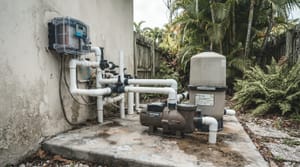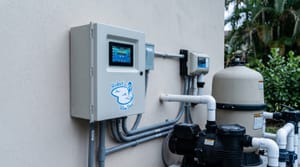
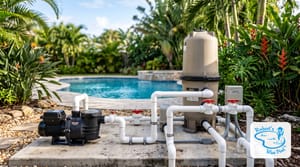
Your pump hums at 3,450 RPM from sunrise to sunset. It has done that since the pool was built, and the FPL bill never says a word about it. Then you do the arithmetic: 1,500 watts, ten hours a day, 365 days a year. That is 5,475 kilowatt-hours, and on a Miami-Dade summer bill it adds up to about $780.
Most pools here run a pump two sizes bigger than the plumbing and filter can use. The pump works hard, moves more water than the pipes carry, and you pay for every extra turn of the motor.
Start With Your Pool's Real Flow Number
The industry norm is two turnovers a day, which means moving your full volume of water through the filter once every 8 hours. The formula is volume divided by 8 hours divided by 60 minutes. A typical 15,000-gallon Miami-Dade pool needs about 31 gallons per minute. A pool of 12,000 to 18,000 gallons lands between 25 and 38.
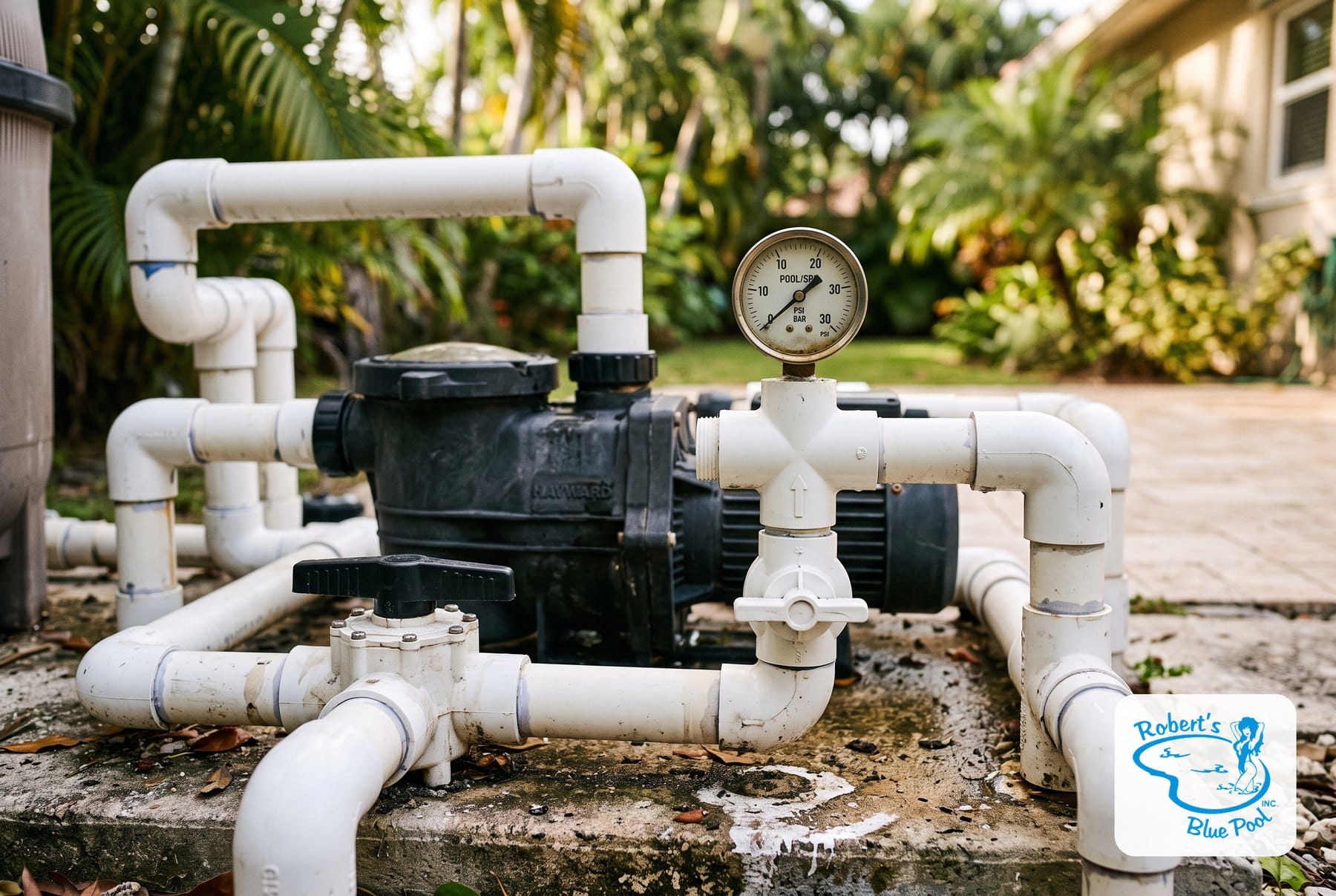
Now check what the plumbing allows. 1.5-inch PVC tops out near 42 gallons per minute, and 2-inch PVC handles up to 73. Push a 2 HP single-speed pump through 1.5-inch lines and the water races past the filter, the motor runs hot and the pool gets no cleaner. Pools built in the 1990s and 2000s are the usual offenders.
What the Federal Rule Changed in 2021
The U.S. Department of Energy adopted its dedicated-purpose pool pump standards in 2017, and they took full effect on July 19, 2021. The Florida Swimming Pool Association summarizes the scope: pumps from 1 to 5 mechanical horsepower, which is 0.711 to 2.5 hydraulic horsepower. The rule never uses the words variable speed. Yet at those sizes only variable-speed pumps meet it.
That does not mean your old pump has to go. FSPA notes that existing pumps can still be repaired while replacement motors stay on the market. It does mean a replacement in that size range is a variable-speed pump. Our guide on when to repair or replace pool equipment walks through that call.
The FPL Math on a Pump That Runs All Year
Northern pools run five to seven months. Yours runs ten to twelve. That gap is why Miami owners see the biggest payback from a pump swap.
FPL's January 2026 residential tariff bills the first 1,000 kilowatt-hours at 12.258 cents each and every kilowatt-hour above that at 14.258 cents. A pool pump sits on top of the rest of the house, so its energy often lands in the higher tier.
A 1.5 HP single-speed pump draws 1,500 to 2,500 watts all day. Run at 1,500 watts for ten hours and the pump alone uses about 5,475 kilowatt-hours a year, near $780 at 14.258 cents. A variable-speed pump at a low setting pulls 150 to 700 watts. Run it at 400 watts for the same ten hours and the year drops to about 1,460 kilowatt-hours, close to $208. Those are our figures from the published rate, and your bill will vary with your usage and the speeds you set.
What a Correct Replacement Looks Like
The Pentair IntelliFlo VSF drops to 600 RPM, against the 3,450 RPM a single-speed pump spins every minute it runs. Hayward's EcoStar and TriStar VS lines work the same way. The principle is the same across brands: low speed for filtering, a short high-speed burst for the cleaner or a waterfall.
Get the flow number first, then match the pump to your plumbing and filter. A pump sized for a 15,000-gallon pool with 2-inch lines sits near 31 to 40 gallons per minute at about 50 feet of total dynamic head. Do not size it from the label on the old motor.
Hurricane season runs through November 30, so outages are still possible. Check the pump timer after any outage, because a reset clock can leave the motor idle or running at full speed for days.
Same-for-same pump swaps in Miami-Dade do not need a permit. A new installation or a change to the circuit does, and any wiring should go to a licensed electrical contractor or a licensed pool contractor with electrical authority. Pool pump circuits also need GFCI protection. Leave that part to a professional.
Salt systems, heaters and automation share the pad with the pump, so a new pump is a good moment to look at them too. If your salt cell struggles in summer, read our fix list for salt cell trouble in July. Robert's Blue Pools has serviced Miami-Dade pools since 2007, and a pump that fits the plumbing is one of the cheapest fixes we see.
Wondering whether your pump is two sizes too big? Call Robert's Blue Pools at (305) 762-7665 and we will check it against your plumbing and filter.