Your pool light burned out in June. You called for a replacement lamp and learned the 300-watt bulb your fixture takes no longer exists. Pentair removed the 100W and 300W Amerlite incandescent lights from its specifications after the U.S. Department of Energy tightened its rules on incandescent lamps. The part you want is obsolete.
That dead bulb is now a decision about the whole fixture, and in Miami-Dade County the code makes most of the decision for you.
The Miami-Dade Pool Light Rule Most Homeowners Miss
Miami-Dade County requires an electrical permit for any repair or replacement of electrical equipment on an existing swimming pool. For a pool light the County charges a reduced fee of $65. The County explains the discount on its own permit page: faulty underwater lights cause serious injuries, and older pools running high-voltage bulbs carry the most risk.
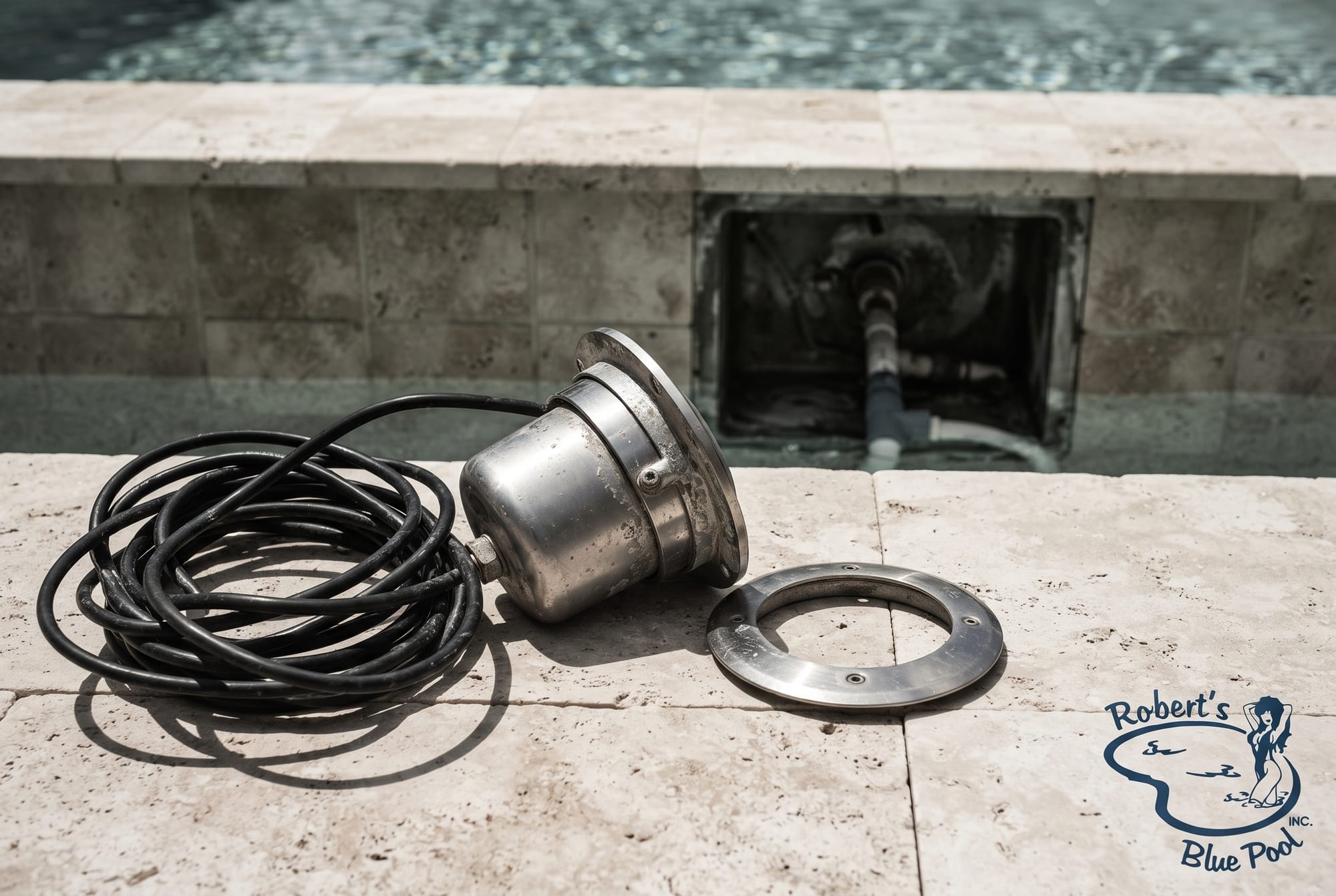
The sentence that catches people sits one line below. Existing residential pools must meet the low-voltage requirements at the time of repair or alteration of an existing pool light. You cannot drop a new 120-volt fixture into an old 120-volt niche. The moment you touch that light, you convert to low voltage. A $40 bulb swap turns into a fixture replacement, and a fixture replacement turns into an LED decision. Our Miami-Dade pool regulations guide covers the rest of the permit landscape if you are planning other work at the same time.
What an LED Pool Light Saves You on the FPL Bill
Pentair rates the IntelliBrite 5G color pool light at 26 watts, and the spa version at 18. Hayward lists the ColorLogic 320 at 25 watts. Compare those numbers to the 500-watt Amerlite lamp still sitting in plenty of Miami pools built before 2010.
Run a 500-watt light five hours a night, every night, and you burn 912 kWh a year. FPL's Residential Service rate effective January 2026 lands near 12.3 cents per kWh once you add the energy charge, fuel charge, storm protection, and the smaller line items. That one light costs you about $112 a year. The 26-watt IntelliBrite on the same schedule uses 47 kWh and costs about $6. You keep roughly $106.
Now the honest version. A fixture plus installation runs several hundred dollars, and the permit adds $65. On energy savings alone an LED pays for itself in three to five years, but only if you actually run the light every night. Most Miami homeowners light the pool on weekends. If that describes you, the electric bill will not close the argument.
The money shows up somewhere else. You stop buying replacement lamps every year or two, and you stop paying a technician to open the niche to change one. That same FPL math shows up at much bigger scale in how your pool pump is sized, which is where we tell most customers to look first if the goal is a smaller bill.
Color LED vs. White LED: Which One You Will Actually Use
Pentair builds the IntelliBrite 5G with five fixed colors and seven light shows. Hayward gives the ColorLogic 320 ten colors and seven shows. Both cost more than a plain white LED.
Ask how you use the backyard after dark. A pool that hosts people on Saturday nights earns the color fixture. A pool nobody swims in past sunset does not. White LED costs less and throws cleaner light for swimming.
Check the Beam Pattern Before You Buy
Pentair ships the IntelliBrite 5G with a wide mode for side-wall mounting and a narrow mode that pushes light down the length of a pool. Put a wide-mode fixture on a long lap pool in Pinecrest and the far end stays dark. Getting this wrong costs you a second fixture and a second permit.
Automation: Buy What You Will Use
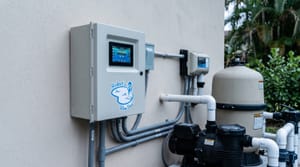
Color LEDs need a controller to be worth the money. Pentair syncs the IntelliBrite 5G to its IntelliCenter system or to a standalone Color Sync controller. Without one, you change colors by flipping the breaker on and off in a counting sequence. That gets old by the second party.
If you already run Pentair or Hayward automation, match the light to the brand on your equipment pad. If you run neither, a standalone color controller costs a fraction of a full automation system and does the one job you need. Robert's Blue Pools gives customers in Coconut Grove and Key Biscayne the same advice: buy the controller you will touch, not the one in the brochure.
Salt Air Decides How Long the Trim Lasts
If your pool sits on a barrier island, salt air pits the stainless face ring faster than it does inland. Robert's Blue Pools pulls corroded trim rings off Bal Harbour and Bay Harbor properties years before we see the same wear in Kendall. Ask about trim material and gasket condition when you spec the fixture. A $400 light behind a rusted face ring reads as a $40 light from the deck, and a failed gasket puts water where the County wrote the code to keep it out.
How the Permit and Install Actually Go
A licensed and insured electrical contractor files the application with Miami-Dade, either through the County's e-permitting system or in person at the Herbert S. Saffir Permitting and Inspection Center at 11805 SW 26 Street. County staff confirms the license and issues the reduced-fee permit. After the work, a County electrical inspector signs off on code compliance.
The County lists one more option, and it costs nothing: disconnect power to the light at the panel. That closes the safety issue and leaves you with a dark pool. If a builder is putting in a new pool, the County does not require a light at all.
Skip the DIY version. Miami-Dade wants a licensed electrical contractor's name on the permit, and 120-volt wiring running to a fixture underwater is not a Saturday project. If your light is out and you want the fixture, niche, and bonding checked before you spend anything, our pool repair team can tell you what you are working with.
Call Robert's Blue Pools at (305) 762-7665 and we will inspect your pool light, niche, and bonding, then tell you what the low-voltage conversion will actually cost.