A pump motor that runs eight years in Kendall gives out in five on a Sunny Isles rooftop deck. Same brand, same install, half the life. The difference blows in off the Atlantic every day and settles on your equipment.
Salt Air Is the Real Cost of a Water View
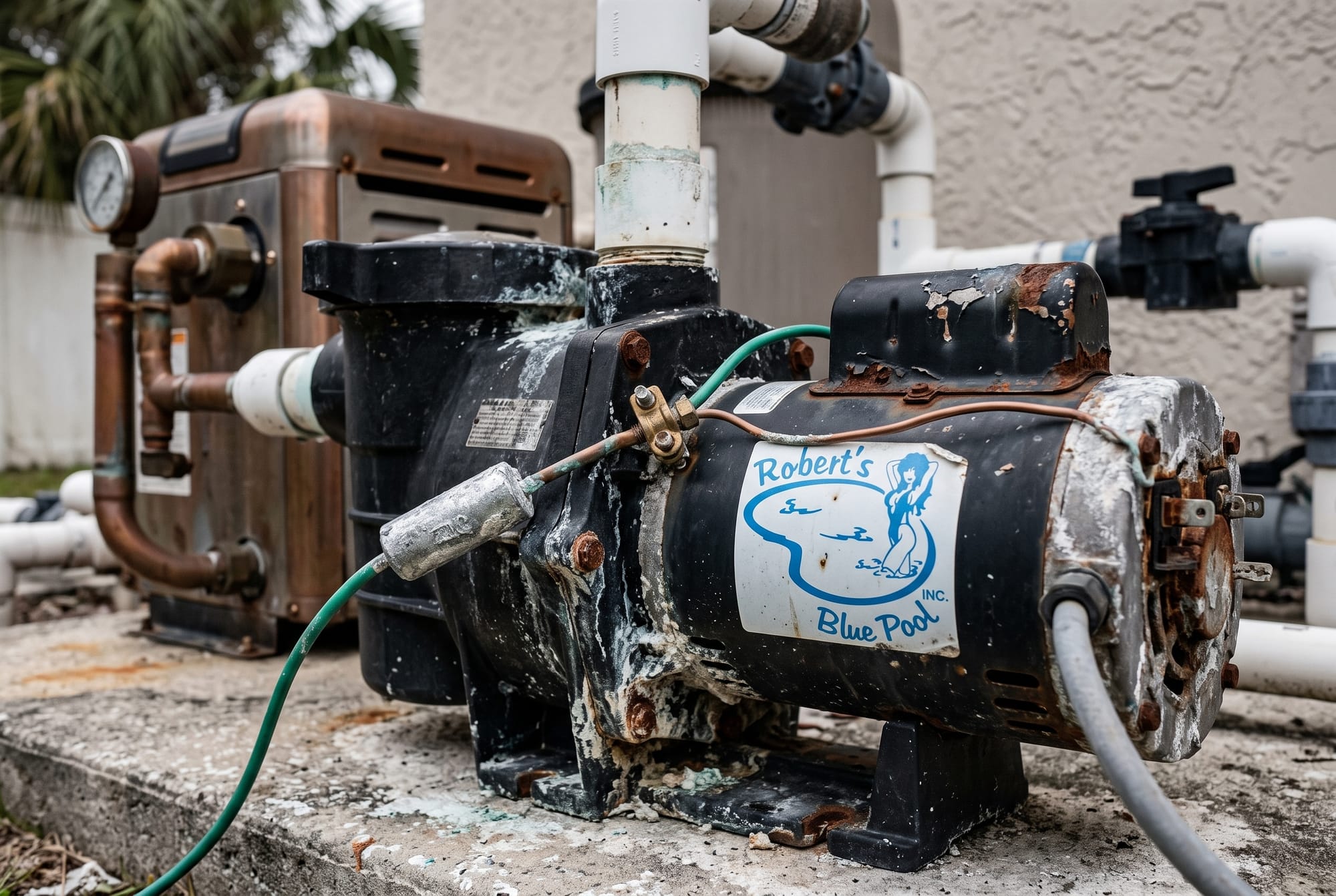
You paid for the ocean, and your pool equipment pays for it too. Salt spray drifts inland as a fine aerosol and lands on motor housings, bolts, electrical terminals, ladder rails, and light rings. The corridor from Biscayne Bay north through North Miami Beach to Sunny Isles shares one condition: bay-front and ocean-front lots take salt year round. On new fittings, rust streaks can show inside a single season.
Robert's Blue Pools has serviced this coast since 2007, and the pattern holds on every barrier-island route we run. The water looks fine from the deck. Open the equipment cabinet and you see where the salt went to work.
What Corrodes First, and How to Slow It
Metal Hardware and Fixtures
Grade-304 stainless is the common builder spec, and it pits on the coast. Chloride ions break down the thin oxide layer that protects the steel, and the pitting works underneath the surface until a rail or screw fails with no warning. Marine-grade 316 stainless carries two to three percent molybdenum, which holds off chloride pitting far longer. When you replace ladders, rails, or light trim rings on a coastal pool, specify 316. You pay more once instead of paying again every few years.
Heaters and Bonded Metal
Standard copper heat exchangers corrode fast in salt air. Cupro-nickel exchangers, the kind Hayward builds into its H-Series and HDF heaters and Pentair uses in the MasterTemp line, resist it and belong on any coastal or saltwater pool. For the metal you cannot upgrade, a sacrificial zinc anode is the defense. Bonded inline to satisfy NEC 680.26(C), which calls for a corrosion-resistant conductive surface in contact with the water, the anode corrodes in place of your heater, rails, and lights. Plan on a fresh zinc roughly every three years. We walked through the same corrosion chemistry for barrier-island owners in our Bal Harbour salt-air guide.
Wind-Driven Debris Loads Your Filter Faster
The same sea breeze that cools your deck carries leaves, sand, seed pods, and palm litter into the water most of the day. A bay-front skimmer basket fills faster than one two miles inland. Your filter loads faster too, so you get shorter runs between backwashes or cartridge cleanings and more strain on the pump. Skip a week of skimming here and the debris sinks, stains the finish, and packs the basket by the time you get to it.
Wind is also why your enclosure and deck hardware carry the ratings they do. Miami-Dade sits in a High-Velocity Hurricane Zone with a 175 mph design wind speed for standard structures, and the entire county is a Wind-Borne Debris Region under the Florida Building Code. Sunny Isles Beach, a barrier-island city in northeast Miami-Dade, falls under the same rules. Screens, panels, and anchors around your pool need to meet Miami-Dade product-approval standards, not generic ones.
Resurfacing on a Coastal Clock
Salt and constant sun age a pool finish faster on the water than inland. Waterline tile picks up scale and staining, and plaster or quartz surfaces show wear sooner than the same materials would in a shaded inland yard. If you own along the Biscayne Bay corridor, our Biscayne Bay pool services page lays out how Robert's Blue Pools handles resurfacing and repairs for this stretch of coast.
The fix for all of it is rhythm, not heroics. Weekly attention keeps salt off the pad, debris out of the basket, and chemistry steady before a small problem turns into a repair bill. A regular schedule costs less than the corrosion and callbacks it prevents, which is the point of our weekly maintenance plans built for Miami-Dade pools.
Own a pool from Biscayne Bay to Sunny Isles? Call Robert's Blue Pools at (305) 762-7665 for a free coastal inspection, and we'll tell you what the salt is already doing to your equipment.