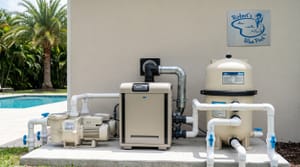
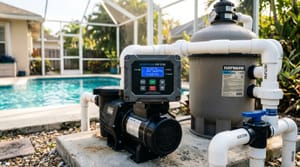
Your pool pump runs 10 to 12 months a year in Miami-Dade. That makes it the single largest electricity draw on your property after your air conditioner. And most residential pools in South Florida have pumps that are too big for the job.
Builders in the 1990s and 2000s installed oversized single-speed pumps on pools across the county. A 15,000-gallon backyard pool in Coral Gables got the same 2-horsepower motor as a 25,000-gallon commercial build in Aventura. Bigger moves more water, more water means a cleaner pool. That was the reasoning. It was wrong.
How Pool Pump Sizing Works
A pump needs to turn over the full volume of water once every 8 hours. Two turnovers per day keeps water filtered and chemicals distributed. For a standard Miami-Dade residential pool at 15,000 gallons, that works out to about 31 gallons per minute (GPM).
The formula: pool volume ÷ 8 hours ÷ 60 minutes = minimum GPM.
Most 2-inch PVC plumbing systems in Miami homes handle up to 73 GPM. A 1.5-inch system caps at 42 GPM. Push water faster than the pipe diameter allows, and you get friction loss, cavitation at the impeller. The motor overheats trying to force fluid through a bottleneck.
An oversized pump on undersized plumbing does not clean the pool faster. It burns electricity and shortens the motor's life.
What Oversizing Costs You in Miami-Dade
A 1.5-horsepower single-speed pump pulls 1,500 to 2,500 watts every hour it runs. At FPL's current residential rate of $0.12 to $0.16 per kilowatt-hour, that adds $600 to $1,200 per year to your electric bill for pool circulation alone.
A variable-speed pump rated for the same flow runs at 150 to 700 watts, depending on the speed setting. Annual cost: $150 to $300. Robert's Blue Pools sees this gap on service calls across Miami-Dade every week. Homeowners pay four to six times more than necessary for pump operation and never question it because the number has been baked into their FPL bill for years.
The payback period on a variable-speed upgrade in South Florida runs 18 to 24 months. In northern states where pumps sit idle half the year, that timeline stretches past four years. Our year-round swim season makes the math land faster than anywhere else in the country.
Federal Law Killed the Single-Speed Pump
The U.S. Department of Energy ruled on July 19, 2021 that all new residential pool pump motors 1.15 HP and above must be variable-speed. Manufacturers can no longer build single-speed pumps at those ratings for residential pools.
A second phase took effect in September 2025: replacement motors for existing pumps in that horsepower range must also meet variable-speed standards. A third tier arrives in 2027 with tighter efficiency floors.
If your pump fails tomorrow and rates 1.15 HP or above, your replacement will be variable-speed by law. You can wait for that failure and pay emergency-service rates, or you can plan the swap on your own schedule and pocket the energy savings in the meantime.
Signs Your Pump Is Oversized
Check the nameplate on your motor. It lists horsepower, voltage, and amperage. Then measure your pool volume (length × width × average depth × 7.5 for gallons). Run the GPM formula above.
If your pump's rated flow at your system's total dynamic head (TDH, usually around 50 feet for Miami inground pools) exceeds the required GPM by more than 30%, you have an oversized pump.
You can also spot the problem without math. The pump housing runs hot to the touch after an hour. The filter pressure gauge reads high within days of cleaning. Water shoots out of return jets hard enough to push a floating chlorine tablet across the pool.
What a Correct Sizing Looks Like
Robert's Blue Pools sizes every pump replacement to the specific pool. We measure volume, check plumbing diameter, calculate TDH with the actual equipment and pipe runs on site, and match a variable-speed unit to the results.
Pentair's IntelliFlo VSF and Hayward's TriStar VS are the two models we install most often in Miami-Dade. Both run as low as 600 RPM for overnight filtration and ramp to 3,450 RPM only when you need high flow for vacuuming or spa jets. That range of speeds is where the savings stack up.
FPL has offered rebates between $100 and $300 for qualifying variable-speed installations through its residential energy programs. Ask us about current availability. We track which rebates are active and handle the paperwork on equipment upgrades included in our weekly maintenance plans.
If your pump is more than 8 years old, running single-speed, or your FPL bill has been climbing without explanation, a pump assessment takes 20 minutes and can save you hundreds per year. Pair it with surge protection before hurricane season, and your new equipment lasts longer than what it replaced.
Call Robert's Blue Pools at (305) 762-7665 to schedule a pump sizing evaluation for your Miami-Dade pool.