Your skimmer basket fills with sea grape leaves by Wednesday. The floor near the sun shelf holds a film of grit that blew in off the street. You want one machine that handles both without running up your power bill. Three types of automatic cleaner compete for that job, and the right one depends on what lands in your pool and how your equipment pad is built.
How the three types work
A suction-side cleaner hooks to your skimmer or a dedicated suction port. Your pool pump powers it, and debris passes through the cleaner into your pool filter. It wanders the floor on a semi-random path. This is the cheapest cleaner to buy and the simplest to fix, with few moving parts and no electronics to fail.
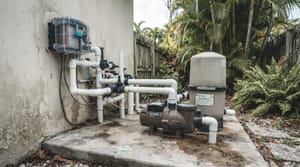
A pressure-side cleaner runs off a separate booster pump. The Polaris PB4-60 booster that drives most of these units is a 3/4 HP motor that pulls 12.8 amps at 115 volts. Water pressure pushes the cleaner around the pool, and debris drops into the cleaner's own mesh bag instead of your filter. Its wide intake swallows leaves, acorns, and pebbles that would choke a suction unit.
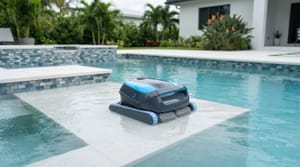
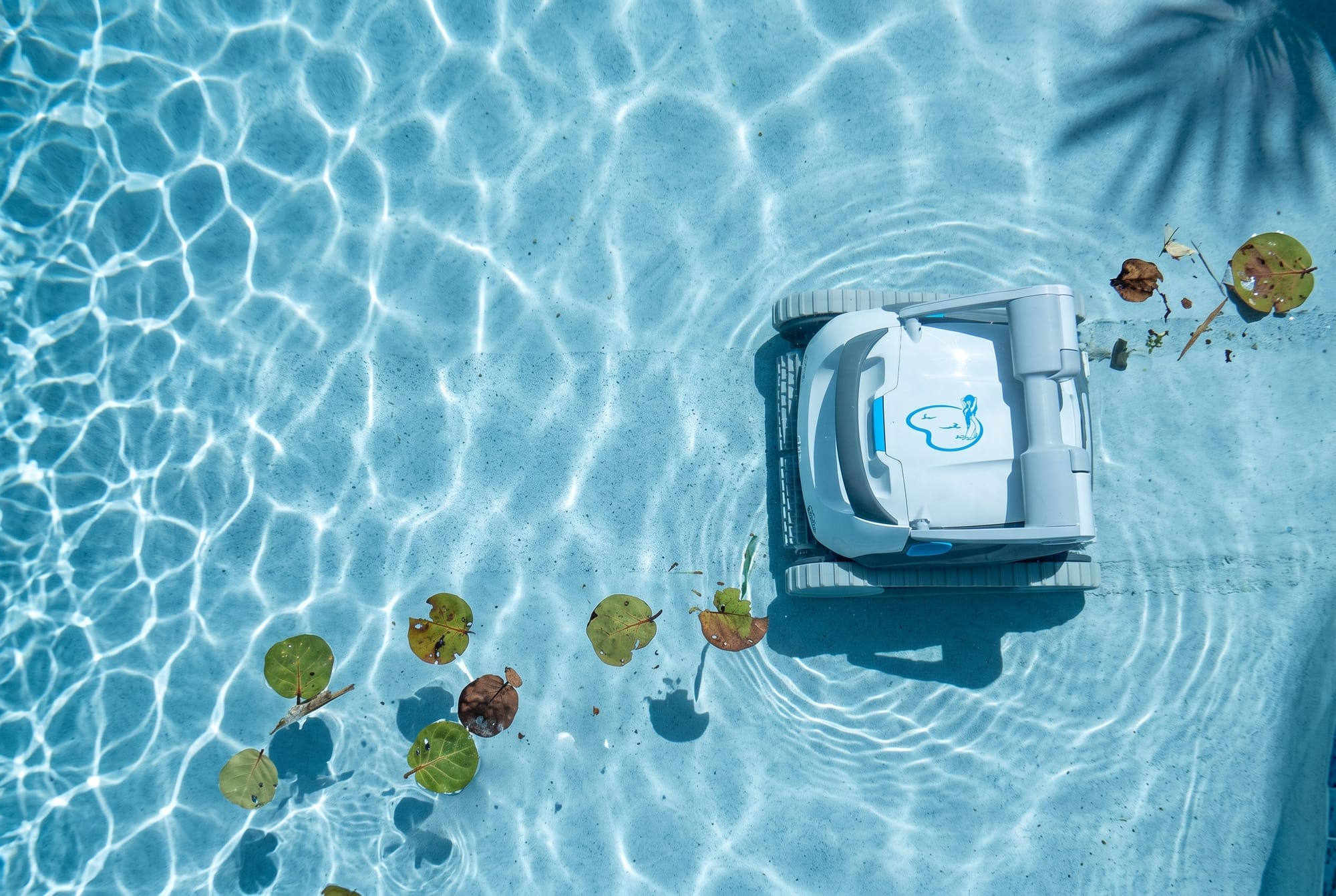
A robotic cleaner skips your pool system. It plugs into a low-voltage outlet and runs on its own motor and drive tracks. A Dolphin Nautilus CC Plus from Maytronics scrubs the floor and climbs the walls in a 2.5-hour cycle, filtering everything into a cartridge you rinse out with a hose. Maytronics rates the run cost near 15 cents a cycle.
What South Florida throws at your pool
Our landscaping sheds year-round. Royal palms drop seed pods, sea grape drops broad leaves, and live oak drops a steady rain of small litter through every month. A screen enclosure catches some of it and funnels the rest straight to your water. That heavy organic load is where a pressure-side cleaner earns its keep, since its bag keeps leaves out of your filter. If your yard buries the pool by midweek, a bagged cleaner and a good weekly maintenance plan keep you ahead of it.
Coastal grit is the other half of the problem. Wind carries fine sand off the barrier islands, and pools in Bal Harbour, Key Biscayne, and Sunny Isles collect a thin sediment on the floor. Large-debris cleaners skate over that dust. A suction cleaner or a robotic cleaner with a fine cartridge pulls it up and holds it.
The power bill math in Miami
Pool pumps in South Florida run 10 to 12 months a year, so anything that adds pump runtime costs more here than in a seasonal market. Suction and pressure cleaners both lean on that runtime. A suction cleaner adds back-pressure to your main pump. A pressure cleaner fires up a 3/4 HP booster on top of it. Between them, industry estimates put the extra electricity at 30 to 150 dollars a season depending on your pump and your rate.
A robotic cleaner draws 100 to 300 watts from a wall outlet and runs independent of the pump, which puts its season cost closer to 5 to 30 dollars. It also spares an aging single-speed pump the extra strain. If your pump is already near the end of its life, read our guide on when to repair versus replace pool equipment before you buy a cleaner that leans on it.
Which cleaner fits your pool
Buy a pressure-side cleaner if oaks and palms bury your pool and you want debris out of your filter. Buy a suction-side cleaner if your debris is mostly fine sand, your pool is small, and your budget is tight. Buy a robotic cleaner if you want the lowest running cost, wall scrubbing, and a machine that leaves your pump alone.
For most pools Robert's Blue Pools services across Miami-Dade, a robotic cleaner is the practical pick. The exception is a heavily shaded lot under mature trees, where a bagged pressure cleaner still wins on volume. When a cleaner breaks or a pump strains under an old suction unit, our pool repair team sorts out which part actually failed.
Not sure which cleaner suits your pool and your equipment pad? Call Robert's Blue Pools at (305) 762-7665 and we will match one to your debris, your pump, and your budget.