You run a hand along the coping one morning and a waterline tile shifts under your thumb. A few days later a crack runs through the grout behind it. The pool looked fine in March. Now it is late June, the deck has baked past 90 degrees for weeks, and something let go. This is one of the most common summer calls Robert's Blue Pools gets, and the tile is rarely the real problem.
Heat Moves Your Pool Deck More Than You Think
Concrete grows when it heats. The American Concrete Institute puts the thermal expansion of normal-weight concrete at about 5.5 millionths of an inch per inch for every degree Fahrenheit (ACI 318, AASHTO T336). The Federal Highway Administration turns that into something you can picture: a 50-degree swing stretches a 100-foot slab by roughly half an inch. Your deck is shorter than that, but the math still bites. A pool deck in direct Miami sun runs far hotter than the air around it. The National Weather Service logged 70 days at or above 90 degrees across South Florida last summer, above the normal of 64. On each of those days the deck expands at midday and shrinks overnight. That movement has to go somewhere.
The Expansion Joint Does the Real Work
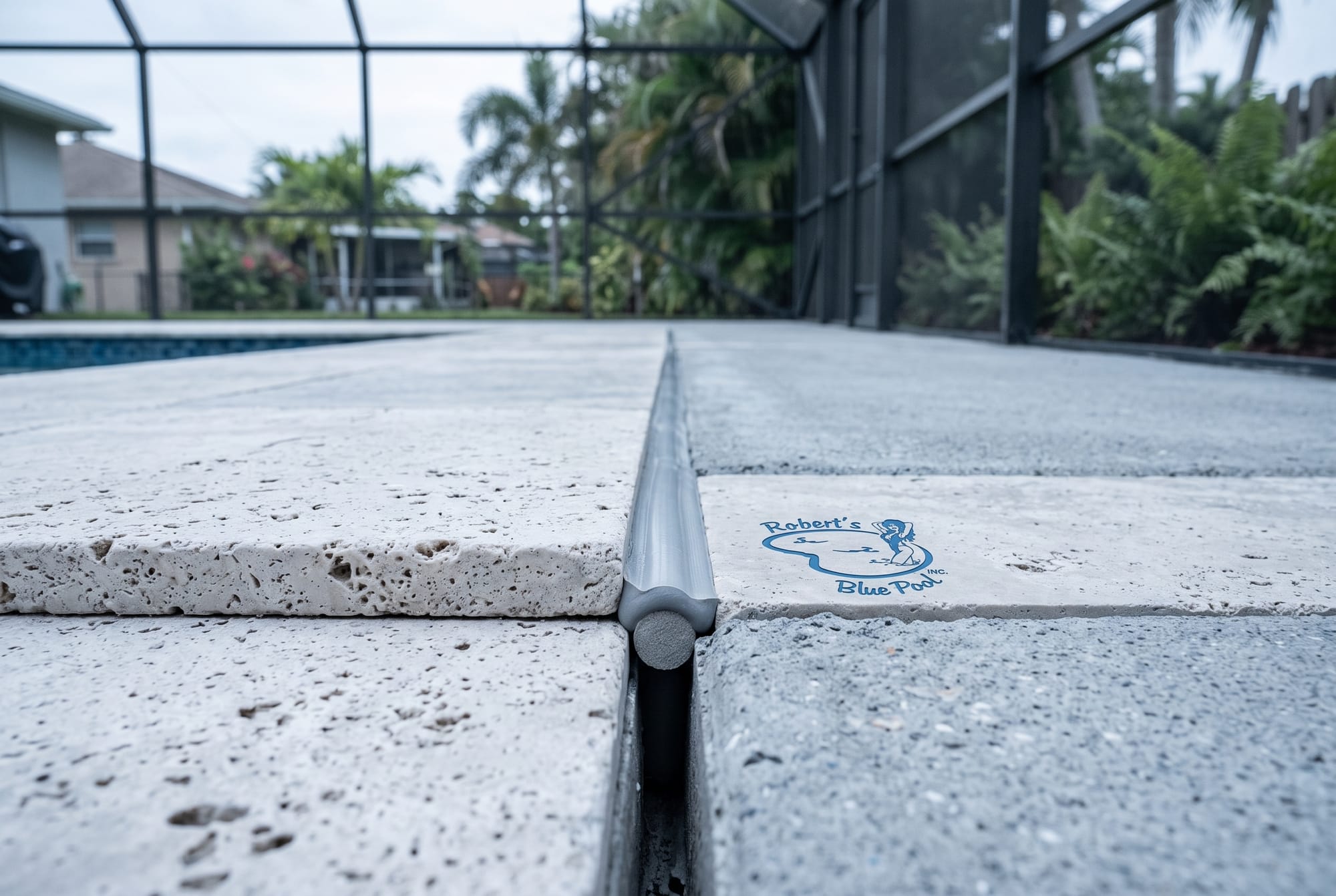
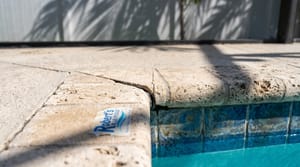
Look at the seam between your deck and the coping. That gap is the expansion joint, and it is the part keeping your tile alive. It holds a foam backer rod topped with a flexible sealant called mastic. The joint gives the deck room to move so it never leans on the pool shell.
A healthy bead stretches and compresses with the daily heat cycle. Deck-O-Seal, the two-part polysulfide sealant from W.R. Meadows, handles up to 25 percent joint movement and resists pool chemicals. Sika makes pool-grade sealants that pour into the joint and stay elastic for years. Either one, set over the right backer rod, buys your coping a long quiet life.
Why the Tile Cracks First
When the mastic dries out and quits, the deck transmits its full expansion into the coping. The weakest link sits right behind the tile, where the coping meets the shell. Pressure builds there until the bond breaks. You get hairline cracks in the grout, a tile that sounds hollow when you tap it, or a corner that lifts off the bond beam. Lifting tile and coping is one of the warning signs we walk through in our guide to when a Miami pool needs repair. Catch it while it is still a sealant job and you spend a couple hundred dollars. Wait until water drives behind the tile and you are looking at pool repair on the shell itself.
Coping Material Changes How Hard the Deck Fights Back
Material matters under our sun. Travertine, common on decks around Coral Gables and Pinecrest, stays cooler underfoot than poured concrete, near 110 to 120 degrees against concrete's 130 to 140 on a 95-degree afternoon, and its porous face grips when wet. Concrete absorbs heat and moves more, which feeds the expansion cycle that strains your joint. No surface is immune. A concrete deck with a dead joint will crack tile no matter how good the stone above it looks. If your coping is spalling and your plaster is failing at the same time, the cracking may signal the whole surface is near the end of its run. Our post on how often to resurface a pool in South Florida covers that call.
What to Check Before August
You can read this seam yourself in five minutes. Walk the full perimeter of the pool and look at the joint between the deck and coping.
- Press the mastic with a finger. It should give a little. If it is rock hard, crumbling, or split away from the stone, it is done.
- Look for a gap behind the bead where water can run in. Open joints feed the shell during our afternoon storms.
- Tap along the waterline tile. A hollow ring means the bond is already loosening.
- Check the coping stones for any that rock under hand pressure or sit higher than their neighbors.
Find any of these now and the repair stays small. The rainy season is the worst time to leave an open joint, because every storm pushes water into the gap and under the deck. Robert's Blue Pools keeps that joint on the inspection list for every pool we service.
Walk your coping line this week. If the seam looks dry, cracked, or open, call Robert's Blue Pools at (305) 762-7665 and we will reseal it before the heat turns a caulk job into a cracked-tile repair.