
You stand at the edge of your pool with a tape measure and a marker. The water sat at 6 inches below the tile two days ago. Now it's at 7. No party, no rain, no wind. Just water leaving your pool and going somewhere it shouldn't.
That's a repair signal. Catch it now and you're looking at a few hundred to a few thousand dollars. Wait six months and the same problem turns into a renovation quote that starts at $15,000.
Repair work and renovation are two different conversations. Renovation rebuilds the pool. Repair fixes the part that's failing so the rest of the pool keeps doing its job. The trouble is most homeowners in Miami-Dade can't tell which signals mean "call someone Tuesday" versus "this can wait until next year." Here are the five signs that mean Tuesday.
1. Water loss greater than a quarter inch a day
Every uncovered pool in South Florida loses water to evaporation. The EPA puts annual evaporation between 12,000 and 31,000 gallons depending on heat, humidity, and wind. In a coastal Miami summer with 90-degree afternoons and afternoon thunderstorms that bring zero water in but plenty of wind, the high end is realistic.
What that translates to day-to-day is roughly 1/8 to 1/4 inch of drop per day during summer, less in winter. If you measure more than 1/4 inch of loss per 24 hours and you haven't had a pool party or a windy stretch, you have a leak. Tape a piece of duct tape on the tile at the waterline. Check it the next morning. If the gap grows past a quarter inch a day for three days running, stop guessing and call.
Leaks in Miami-Dade pools hide well because of the high water table. Water exits through a cracked return line and disappears into the ground without ever pooling on the deck. By the time you see settling pavers or a soggy patch of grass, the pool has been losing water for months.
2. Cracks you can fit a coin into
Hairline cracks in plaster are cosmetic. Most South Florida pools develop them within five to ten years from heat cycling and chemical wear. They're not pretty, but they don't threaten the shell.
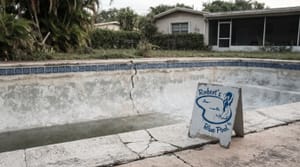
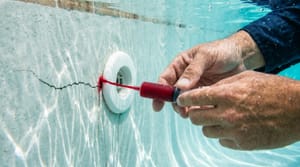
The cracks that matter are 1/8 inch wide or more. If you can slide a dime into a crack in the floor, the wall, or the bond beam, that crack runs through the gunite. Pools sit on sandy and limestone soil across Miami-Dade, and that substrate shifts with rainfall and the water table. When the ground moves, the shell moves with it. A crack that "breathes," opening and closing as you fill and lower the water, is an active structural crack.
Repair on a structural crack while it's small typically runs $3,000 to $8,000 with hydraulic cement, epoxy injection, and spot resurfacing. Let it propagate and you're looking at a full resurface job on top of structural repair, which puts the bill in the $15,000 to $40,000 range.
3. Pump that's louder than it was a year ago
Pool pumps run 8 to 12 hours a day in Miami year-round. That's between 2,900 and 4,400 hours of runtime annually, more than three times what pumps in northern markets see. The bearings, the seals, and the motor capacitor all wear at South Florida-speed.
The first warning is sound. A pump that develops a grinding, screeching, or rattling note has bearing wear. A pump that hums but won't start has a failed capacitor. Both repairs cost a fraction of replacement if you catch them early. A bearing replacement on a Pentair or Hayward pump is a few hundred dollars in parts. Run the pump until the motor seizes and you're buying a new pump, which now means $1,200 to $2,500 plus install.
Same logic on the heater: any new noise, any drop in heat output, any error code on the display. These are repair signals, not "wait and see" signals. Per Miami-Dade County permit rules, equipment swaps don't require a general permit (heaters being the exception), and most electrical work on existing equipment does require an electrical permit. A licensed pool company will pull what's needed.
4. Stains that won't brush out
Brown, green, or rust-colored stains that won't respond to brushing or shock are usually metal coming out of solution and binding to the plaster. Iron from well water, copper from a corroded heater core, or calcium scale from South Florida's hard water all show up as discoloration that looks like it's painted on.
The repair on a copper stain is two-part: chelate the metal out of the water and find the source of the copper. If the source is a heater that's leaking copper into the water, you're looking at a heater repair or replacement before any cosmetic fix sticks. Skip that diagnosis and you'll re-stain the pool within weeks of resurfacing.
Calcium scaling has its own pattern: rough white deposits along the waterline and around fittings. Left alone for a year or two, calcium binds into the plaster and the only fix becomes acid washing or resurfacing. Caught early, balancing calcium hardness and adjusting pH keeps the surface intact for another decade.
5. Tile falling off, coping lifting, or deck pulling away
Tile that falls off the waterline isn't just cosmetic. It's a sign that water has gotten behind the tile bed, the grout has failed, or the bond beam is shifting. Coping stones that lift or rotate tell you the same thing about the structure between the pool and the deck.
If you can slide a credit card into the gap between the coping and the deck, water is getting under there every time it rains. In Miami-Dade's daily summer storms, that's 60-plus rainfall events between June and October eroding the soil under your deck. The repair while it's a coping seal job is in the low thousands. The repair after the deck has settled and cracked is a full deck replacement on top of the coping work.
What to do if you spot one of these
Document it. Take a photo with something for scale next to the crack, the stain, or the gap. Note the date and the water level. Then call. The point of catching these early is the math: a repair budget protects the renovation budget. Letting one item turn into three is how a $5,000 problem becomes a $30,000 problem.
Robert's Blue Pools has been working on Miami-Dade pools since 2007. We diagnose what's actually wrong before quoting work, and we tell you when something can wait. If any of the five signs match what you're seeing, book a repair inspection or get on a weekly maintenance plan that catches problems before they grow.
Call (305) 762-7665 to set up an inspection.