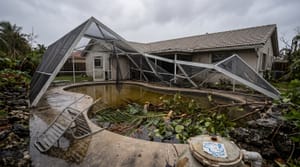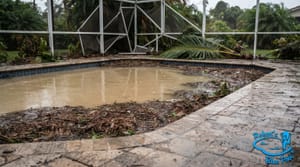
A named storm passes over Kendall or Palmetto Bay, and by morning your pool is a mess. Screen panels torn loose, a cracked tile at the waterline, debris on the bottom, and a pump that won't prime. Your first question is whether homeowners insurance pays for any of it. The honest answer for most Miami-Dade pool owners is: sometimes, and the timing and the numbers decide it more than the damage does.
Robert's Blue Pools has walked hundreds of South Florida homeowners through the days after a storm since 2007. The pattern repeats every hurricane season. People either file a claim they should have skipped, or they skip one they should have filed, because nobody told them how pool coverage actually works.
How Your Policy Sees Your Pool
Most standard Florida homeowners policies put an in-ground pool under Other Structures, called Coverage B. That bucket also holds your fence, a detached garage, and a shed. Coverage B usually caps out at 10% of your dwelling limit. On a home insured for $500,000, that gives you roughly $50,000 for everything detached from the house, your pool included. If your pool shares a wall or foundation with the home, some carriers move it to Dwelling, Coverage A, which carries a higher limit.
Wind is a covered peril. When hurricane-force wind drives a palm through your pool cage or cracks your deck, that damage falls inside your policy. Flood is a separate story. Standard homeowners insurance does not cover flood, and storm surge or rising groundwater that pushes contaminated water into your pool is a flood event, not a wind event. That cleanup runs through a National Flood Insurance Program policy if you carry one, or out of your own pocket if you don't. We cover the chemistry side of that job in our guide on what to do when flood water gets in your pool.
The Screen Enclosure Trap
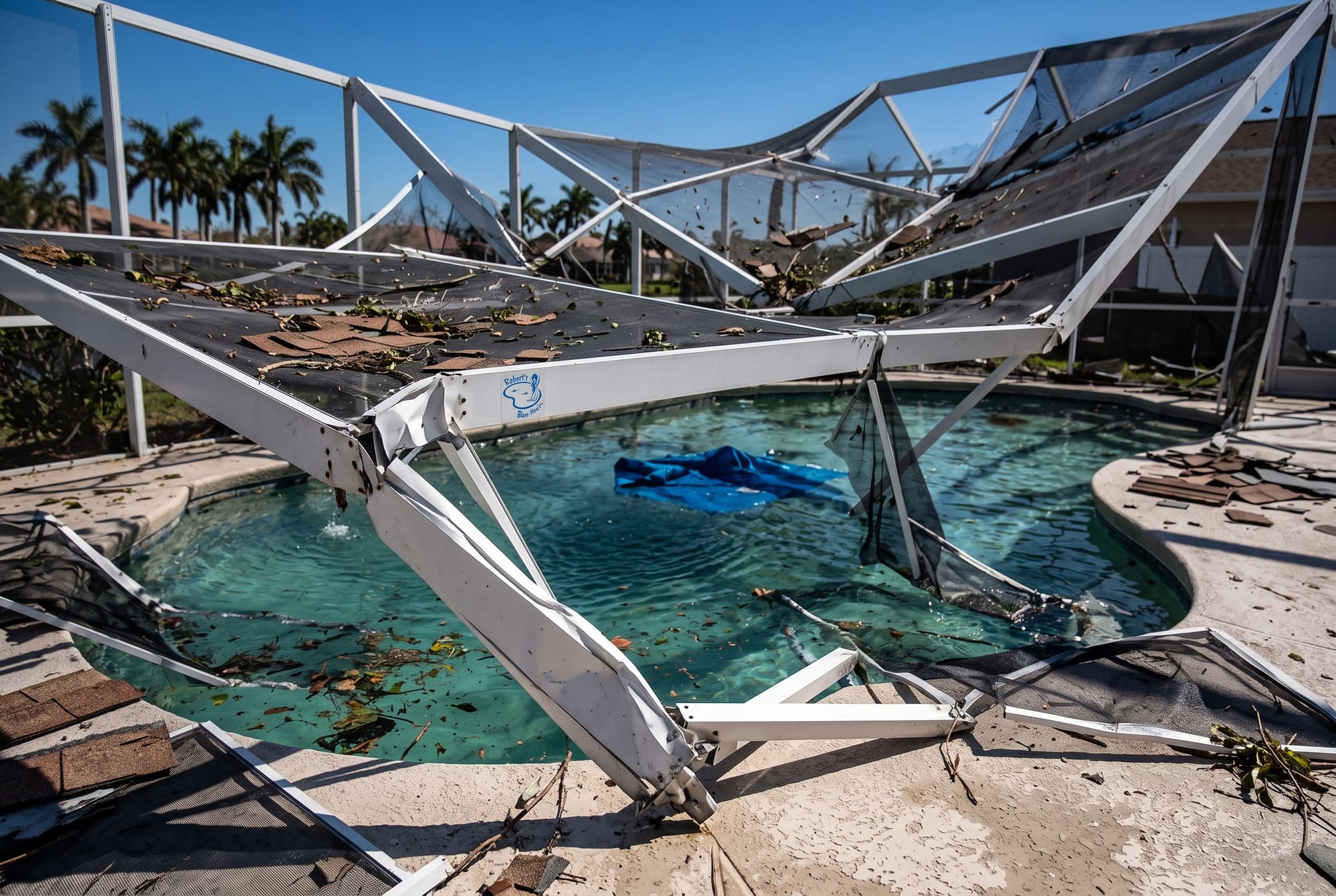
Here is where South Florida owners get surprised. Your pool cage, the aluminum-and-screen enclosure that keeps the leaves and the iguanas out, is often not covered the way the pool is. Many Florida carriers exclude screen enclosures and pool cages, or drop them to a low sub-limit, unless you bought a specific endorsement for them. Pull your declarations page and look for the line item. If it isn't there, a wind-flattened cage that costs $8,000 to $15,000 to rebuild may come back to you entirely. Before the next storm, that endorsement is worth asking your agent about, and so is a hurricane-rated enclosure design, which we break down in our post on choosing a pool enclosure that survives hurricane wind.
The Deductible Math That Decides It
This is the part that stops most pool claims before they start. Florida policies carry a separate hurricane deductible for named storms, and it runs as a percentage of your dwelling coverage, not a flat dollar figure. Florida law, under Statute 627.701, requires insurers to offer deductible options of $500, 2%, 5%, or 10%. Most Miami-Dade homeowners sit at 2% to 5%.
Run your own numbers. A home insured at $400,000 with a 2% hurricane deductible means you pay the first $8,000 yourself. At 5%, it's $20,000. So if the storm left you with a cracked tile, a bent handrail, and a filter that needs a new lateral, you are looking at repairs that total maybe $2,500. That entire bill sits under your deductible. You would file, absorb the cost anyway, and put a claim on your record for nothing. The claim makes sense when the damage clears the deductible: a destroyed enclosure plus a shattered pump pad plus deck cracking that adds up past $20,000.
One more detail in your favor: most Florida policies apply the hurricane deductible once per calendar year, not once per storm. If you already paid it out on an earlier named storm this season, a later storm's damage may be covered above your standard deductible instead.
The One-Year Clock Nobody Mentions
If you do have a claim worth filing, the calendar is not on your side the way it used to be. Florida Statute 627.70132 gives you one year from the date of loss to notify your insurer of a property damage claim, with six extra months for a supplemental claim if you find more damage later. For a hurricane, the date of loss is the day the storm made landfall, as verified by NOAA. The Florida legislature cut this window down from two years, effective for policies dated on or after December 16, 2022. Miss it, and the statute bars your claim no matter how bad the damage is.
One year sounds long until a slow leak from a storm-cracked shell shows up in month eleven. Document everything the day the storm passes, even damage you don't plan to claim yet.
What Adjusters Want to See
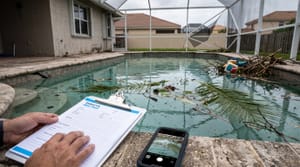
An adjuster pays what you can prove. Before the storm season starts, photograph your pool, cage, equipment pad, and deck in good condition, and save the file with a date. After a storm, photograph the damage from several angles before you clean up anything, and keep any broken parts. Get a written repair estimate that itemizes the storm damage and separates it from ordinary wear. When you start the recovery work itself, our step-by-step guide on post-storm pool recovery in the first 48 hours keeps the cleanup from erasing the evidence you need.
Robert's Blue Pools provides itemized damage assessments that homeowners across Coral Gables, Pinecrest, and the coastal neighborhoods have handed straight to their adjusters. A clear, specific estimate from a licensed pool company carries more weight than a homeowner's guess, and it speeds up the parts of the process you can't control.
Storm hit your pool? Call Robert's Blue Pools at (305) 762-7665 for a free, itemized damage assessment you can take straight to your insurer.