Your Pool Just Filled With Flood Water. Do This First.
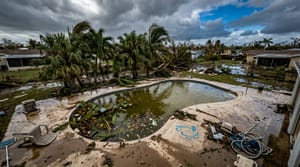
A tropical downpour dumps six inches on Coral Gables overnight. By morning, your pool is brown. The water line sits four inches above the tile. The skimmer is submerged. That water came from your yard, your neighbor’s yard, the street, and the storm drain that backs up every June.
Floodwater in a pool is not the same as rain in a pool. Rain dilutes your chemicals. Floodwater introduces sewage, fertilizer runoff, motor oil, and bacteria your chlorine cannot kill at normal levels. The CDC has documented that Cryptosporidium survives at standard pool chlorine concentrations (1 to 3 ppm) for more than 10 days. E. coli, Giardia, and other pathogens ride in with every gallon of runoff.
You cannot swim in this water. You cannot ignore it. And you need to act before algae gets a 48-hour head start.
Step 1: Lower the Water Level
Bring the water back to the middle of the skimmer opening. Use a submersible pump or your pool’s drain system.
Two rules on where the water goes. Miami-Dade County Code Chapter 24 prohibits discharging anything except rainwater into storm drains. Contaminated pool water cannot go into the street gutter, a canal, or Biscayne Bay. Pump it onto a pervious area of your property, like a grassy section of your yard, where the soil can absorb it. If you live in Miami Beach or Sunny Isles with limited yard space, talk to your pool service provider before pumping.
Step 2: Remove Debris Before You Touch the Chemistry
Skim leaves, branches, mulch, and anything solid from the surface and bottom. Net out what you can see. Vacuum the rest to waste, bypassing the filter. Running contaminated water through your filter clogs the media and pushes bacteria through the system.
If you have a DE filter, plan on replacing the grids or at least the powder after this process. Cartridge filters need new cartridges. Sand filters need a full backwash and fresh sand if the flooding was severe.
Step 3: Triple-Shock the Pool
Standard shocking won’t cut it. You need to raise free chlorine to 30 ppm, which means triple-shocking: 3 pounds of calcium hypochlorite (cal-hypo) per 10,000 gallons. Use cal-hypo, not dichlor or trichlor. Cal-hypo does not add cyanuric acid, and your CYA level is already unpredictable after flood contamination.
Broadcast the shock across the pool surface at dusk. Run the pump continuously for 24 hours. Do not swim until free chlorine drops below 5 ppm, which takes 24 to 48 hours depending on sunlight and water temperature.
Miami’s June sun burns through chlorine fast. In 90-degree water with a UV index above 11 (typical for South Florida from May through September), expect to lose 3 to 5 ppm per day. Test twice daily and re-dose if free chlorine falls below 10 ppm before the 24-hour mark.
Step 4: Clarify and Test
Six hours after shocking, add a two-stage clarifier. The first dose binds suspended particles. The second dose, applied six hours later, drops them to the floor. Vacuum the settled debris to waste the following morning.
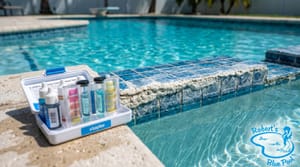
Once the water clears, test for:
- pH: Flood runoff pushes pH down. Aim for 7.4 to 7.6.
- Alkalinity: Target 80 to 120 ppm.
- Phosphates: Floodwater carries phosphates from lawn fertilizer and organic decay. Phosphates feed algae. Test with a phosphate-specific kit and treat with a lanthanum-based remover if levels exceed 200 ppb. Products like Natural Chemistry PHOSfree or Jack’s Magic work for this.
- CYA (stabilizer): Floodwater dilutes your stabilizer. If CYA drops below 30 ppm, add cyanuric acid to protect your chlorine from UV burn-off.
Step 5: Check Your Equipment
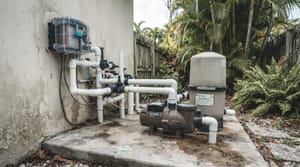
Floodwater can submerge pump motors, corrode electrical connections, and fill equipment pads with silt. Before you flip any breaker:
- Inspect the pump motor housing for water intrusion. If the motor was submerged, do not power it on. Call a licensed pool tech.
- Check the GFCI breaker. If it trips when you try to restart the pump, you have a ground fault that needs professional diagnosis.
- Clean the pump strainer basket and impeller housing. Silt and debris collect here and restrict flow.
- Inspect the heater (if gas or heat pump) for flood damage to the heat exchanger, ignition system, or fan motor.
If you had surge protection installed before the storm, check that the SPD indicators still show green. A power surge during the storm could have tripped your protection without you knowing.
When You Cannot Fix This Yourself
A routine rain overflow, you can handle with a shock and some patience. Flood contamination from a named storm, a sewer backup, or standing water that sat in the pool for more than 72 hours is different. At that point, you are dealing with potential structural damage (hydrostatic pressure can pop a pool shell out of the ground when the water table rises), compromised plumbing, and water chemistry that needs lab testing rather than strip kits.
Robert’s Blue Pools has handled post-storm pool recovery across Miami-Dade since 2007. If your pool took on flood water and you are not sure what you are looking at, call us at (305) 762-7665 before you run the pump.