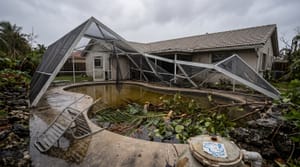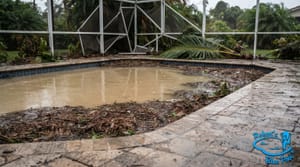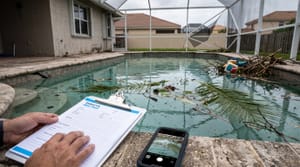
The storm passed six hours ago. Your backyard looks like a construction site. Palm fronds, patio furniture, and chunks of screen enclosure sit in murky brown pool water. You want your pool back, but the order you do things in the next 48 hours determines whether you spend $200 on chemicals or $5,000 on a new pump motor.
Robert’s Blue Pools has handled post-hurricane recovery across Miami-Dade since 2007. This is the sequence we follow after every storm, and it works whether you rode out a Category 1 or a direct hit from a major hurricane.
Do Not Drain the Pool
Start with the thing most people get wrong. Your instinct says pump out the dirty water and start fresh. In South Florida, that instinct will destroy your pool.
Miami-Dade sits on a limestone shelf with a water table just a few feet below ground level. After heavy rain, that water table rises. An empty pool shell has nothing to counteract the upward hydrostatic pressure, and the shell lifts out of the ground. Pool contractors call it “popping.” The Florida Swimming Pool Association warns against draining for this exact reason. Repairs start at $10,000 if the shell shifts even a few inches.
Leave the water in the pool. You will clean it in place.
Remove Debris by Hand First
Before you touch any equipment, grab a leaf rake and a telescoping pole. Pull out branches, screen panels, patio furniture, and anything else floating or sitting on the bottom.
This step matters because debris damages pump impellers. A palm frond sucked into the skimmer line can jam the impeller and burn out a motor in minutes. Clear the skimmer baskets and the pump strainer basket by hand before the pump runs a single cycle.
If your screen enclosure collapsed, remove aluminum framing pieces from the water carefully. Jagged metal edges cut pool surfaces and plumbing fittings.
Check Electrical Before Powering Up
Floodwater and electricity kill people. This is not a step to skip or rush.
Walk to your main electrical panel and check whether the breakers for pool equipment tripped. If standing water reached your pool equipment pad, do not flip those breakers yourself. NEC Article 680 governs pool electrical systems, and a licensed electrician should inspect any motor, control board, or automation panel that sat in floodwater. The cost of an inspection runs $150 to $300. The cost of electrocution is obvious.
If your equipment pad stayed dry and breakers look normal, flip them on one at a time. Listen to the pump. Grinding or squealing means debris made it into the housing. Shut it off and call for pool repair service.
Check your surge protector if you installed one before the season. A spent SPD needs replacement before it can protect your equipment from the next power event. If you skipped surge protection, put it on your list for before the next storm.
Shock the Water Hard
Floodwater carries sewage, bacteria, and chemical runoff. The CDC documents E. coli, Salmonella, and Vibrio vulnificus in Florida floodwater, and Vibrio infections have spiked after recent hurricanes across the state. Your pool water absorbed all of it.
Add calcium hypochlorite (cal-hypo) shock until your test kit reads 10.0 ppm free chlorine. Standard dose: 1 pound of cal-hypo per 10,000 gallons of pool water. Most residential pools in Miami-Dade hold 12,000 to 20,000 gallons, so plan on 1.5 to 2 pounds.
Run the pump and filter continuously for at least 24 hours after shocking. The filter needs to cycle that water multiple times to pull out suspended particles. If you have a cartridge filter, check it after 8 hours. Storm debris clogs cartridges fast.
Test and Balance the Chemistry
Once the chlorine drops below 5.0 ppm (usually 24 to 48 hours after shocking), test and adjust your water chemistry in this order:
Total alkalinity first. Target 80 to 120 ppm. Rain dilutes alkalinity, and low alkalinity makes pH bounce around, which wastes every other chemical you add.
pH second. Target 7.4 to 7.6. Storm runoff tends to push pH low. Sodium carbonate (soda ash) raises it.
Stabilizer (cyanuric acid) third. Target 30 to 50 ppm. Rainwater dilutes CYA, and without it, sunlight burns through your chlorine in hours. South Florida’s UV index hits 11 or 12 in summer. Unprotected chlorine lasts about two hours at that intensity.
Brush, Vacuum, Clean the Filter
After chemistry is balanced, brush every surface: walls, floor, steps, benches. Floodwater leaves a film of silt and organic material that algae feeds on. Brushing breaks that film loose so the filter can capture it.
Vacuum to waste if your system allows it. This sends debris straight out of the pool instead of through the filter. If you can only vacuum through the filter, plan on cleaning the filter media twice in the first week.
Backwash sand and DE filters after every 8 hours of run time during recovery. Replace DE powder after each backwash. Rinse cartridge elements with a garden hose, and consider replacing them if they look stained or compressed.
Know When to Call a Professional
Some post-storm damage goes beyond chemistry and cleanup. Call Robert’s Blue Pools at (305) 762-7665 or schedule a service visit if you see any of these:
Visible cracks in the pool shell or deck that were not there before the storm. Structural settling after heavy rain and soil saturation causes new cracks, and they get worse fast.
Equipment that will not start, makes unusual noise, or trips breakers repeatedly. Storm surge and power surges damage motors, control boards, and wiring in ways that are not visible from outside the housing.
Water that stays green or cloudy after 72 hours of continuous filtration and proper chlorine levels. Persistent discoloration means the filter cannot keep up, or contamination exceeded what standard shocking can handle.
The 48-Hour Timeline
Hour 0 to 4: Remove large debris by hand. Clear skimmer and pump baskets. Inspect electrical panel and equipment pad for water damage.
Hour 4 to 8: Power up equipment (after electrical check). Add cal-hypo shock to reach 10 ppm free chlorine. Start continuous filtration.
Hour 8 to 24: Monitor pump and filter. Clean filter cartridges or backwash as pressure gauge rises. Skim any remaining surface debris.
Hour 24 to 48: Test water chemistry. Adjust alkalinity, pH, and stabilizer. Brush all surfaces. Vacuum to waste. Your pool should be clearing up by hour 36.
NOAA predicts 8 to 14 named storms for the 2026 Atlantic hurricane season, with El Nino expected to keep activity below normal. Below normal still means storms hit Florida. Get your recovery plan set before June 1, and call Robert’s Blue Pools at (305) 762-7665 if your pool needs professional recovery after any storm this season.