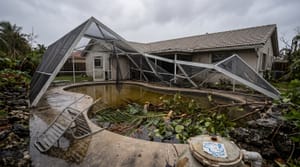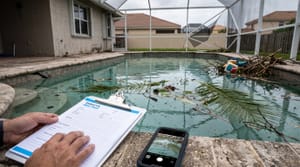
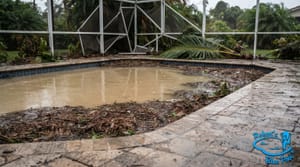
A June storm dumps six inches on Kendall in an afternoon, the canal behind your house tops its bank, and by morning your pool is the color of weak coffee with a rim of mulch floating on top. The water rose past the tile line and brought the yard in with it. Before you reach for the shock jug or pull the drain plug, stop. The order you do things in decides whether this costs you a weekend or two weeks.
What Is Actually in That Floodwater
Floodwater is not rainwater. When a canal or the street backs up into your pool, it carries whatever it crossed on the way in. AQUA Magazine lists the usual load after a South Florida flood: sewage overflow, lawn and yard chemical runoff, seawater near the coast, dead animals, and debris. Along Biscayne Bay and Sunny Isles, storm surge and king tides push saltwater in on top of all of it.
The part you cannot see matters more. The CDC found that Cryptosporidium, a diarrheal parasite, survives more than ten days at the chlorine levels most pools run (1 to 3 mg/L). Normal chlorine does not kill it fast. Treat a flooded pool as contaminated until your test kit says otherwise, and keep everyone out of the water until then.
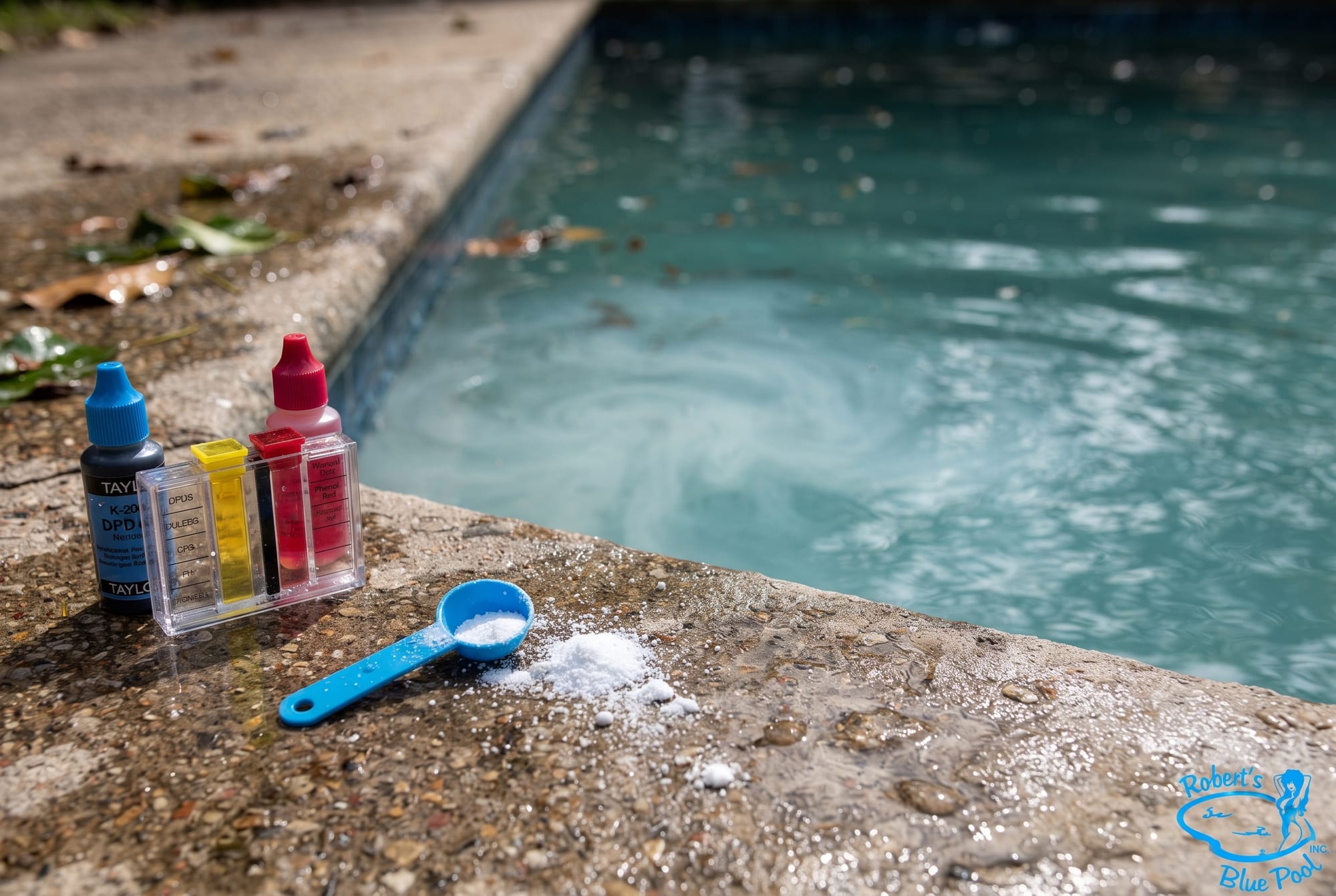
Work the Pool in Order
Robert's Blue Pools has cleaned up flooded pools across Miami-Dade since 2007, and the same sequence works almost every time. Skip a step or run them out of order and you fight the water for days.
- Skim and net the big debris first. Leaves, mulch, and branches on the surface will clog your skimmer and pump basket the moment you turn the system on.
- Shock hard. Raise free chlorine to at least 30 ppm, roughly triple a normal shock, or 3 pounds of pool shock per 10,000 gallons, per InTheSwim's flood recovery guide. Use calcium hypochlorite (cal-hypo). It adds no cyanuric acid, so your stabilizer stays under control.
- Clarify in two stages. Add a chitosan or polymer clarifier, wait six hours, then add the second stage. A flooded pool should clear within 24 hours of that second dose.
- Starve the algae. Floodwater is loaded with phosphates, the main food source for algae. Once the water clears, test phosphates and treat with a lanthanum-based remover like Natural Chemistry PHOSfree until you read below 200 ppb.
- Deal with the filter. Cartridge and DE media that ran dirty floodwater should come out and get replaced. A sand filter needs a full backwash and recharge before you trust it again.
Draining Is Where Miami-Dade Owners Get Fined
Once the pool clears you may want to lower the level, and this is where people get in trouble. Miami-Dade County Code Chapter 24 allows nothing but clean rainwater into storm drains, canals, the bay, or any county water. Contaminated or chlorinated pool water does not qualify. The county has also updated its dewatering standards with specific language for residential pools, and dewatering groundwater into stormwater infrastructure is banned countywide. Our Miami-Dade pool regulations guide breaks down the permits and codes that apply to your property.
The practical version: let chlorine drop to near zero before you release any water, send it to a landscaped area on your own lot where the ground can absorb it, and keep it out of the street drain. If you need to move a large volume, a Class V dewatering permit may apply.
How This Fits the 2026 Storm Season
NOAA's May outlook calls for a below-normal 2026 Atlantic season, with 8 to 14 named storms as El Niño develops. Below-normal is not zero. It takes one storm, or one afternoon where Miami's average 9.7 inches of June rain shows up in a few hours, to put your yard in your pool. The season runs June 1 through November 30, so the risk stays live into fall.
The pools that recover fast are the ones that were healthy going in. If your chemistry and equipment are already dialed, a flood is a weekend of work. If you were behind on upkeep, the flood exposes it. A steady weekly maintenance plan holds your baseline where it needs to be, and getting equipment storm-ready ahead of time is covered in our hurricane season pool preparation guide.
Floodwater in your pool and you would rather not guess at the chemistry? Call Robert's Blue Pools at (305) 762-7665 and we will get it clean and safe to swim.