Your Pool Storm Kit: What to Stock Before June 1
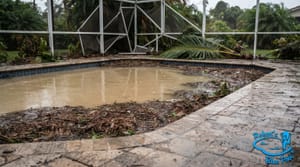
A Category 1 hurricane knocks out power to 400,000 FPL customers in Miami-Dade. Your pool pump goes dark for three days. The rain dumps eight inches of diluted, debris-filled water into your pool. And you’re standing in your garage wondering where you put that bag of shock.
That scenario played out across South Florida during every active storm season since 2017. The homeowners who recovered their pools in days had one thing in common: they stocked supplies before the first storm watch, not during it.
Robert’s Blue Pools has serviced Miami-Dade pools since 2007, and we rebuild the same pools after the same storms year after year. This list comes from what we keep on our own trucks and what we tell clients to buy before May ends.
Chemical Supplies: Shock and Test Kits
Stock at least two pounds of calcium hypochlorite (cal-hypo) granular shock per 10,000 gallons of pool water. Cal-hypo runs 65-75% available chlorine and stores for months if you keep it sealed, dry, and away from other chemicals. The Florida Swimming Pool Association recommends super-chlorinating your pool before any approaching storm. You want free chlorine at 10 ppm or above going into a multi-day power outage, because your pump and chlorinator won’t run until FPL restores service.
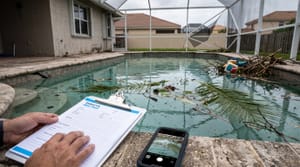
Buy a fresh liquid test kit or test strips that measure free chlorine, pH, alkalinity, and cyanuric acid. After the storm passes, you’ll test before you dose. Old reagents give bad readings. Replace kits older than 12 months.
Keep a gallon of muriatic acid on hand. Storm runoff raises pH fast, and you’ll need to bring it back under 7.6 before your chlorine works at full strength.
Water Removal Tools
A submersible utility pump rated at 1/3 HP or higher is the single most useful post-storm tool you can own. Miami-Dade averages six to eight inches of rainfall per month from May through October, according to the National Weather Service Miami office. A bad tropical system drops that in 12 hours. Your pool will overflow, and your deck drains may not keep up.
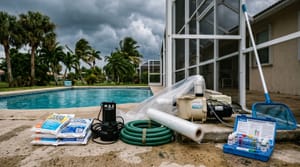
Pair the pump with 50 feet of discharge hose. Run it away from the pool, away from the house foundation, and into a permeable area. Miami-Dade County Code requires pool water discharge to contain no detectable free chlorine (≤0.01 mg/L), so if you need to pump chlorinated water, dechlorinate first or wait 48 hours after the last chemical treatment.
A manual siphon hose (garden hose with a siphon starter) works as backup if you lose power and the pump is useless. Set it up from the pool edge to a drainage point two to three feet lower before the storm arrives. You won’t want to fiddle with hoses in 60 mph gusts.
Equipment Protection
Your pool pump motor, controller, heater, and salt cell are the most expensive things on your equipment pad. A single flood event can destroy a variable-speed pump that costs $1,500 to replace.
Stock these before storm season:
Heavy-duty plastic sheeting, six mil thickness minimum. Cut pieces sized to wrap your pump motor, automation controller, and heater. Secure with zip ties, not tape. Tape fails in rain.
If your equipment pad sits below grade or in a flood-prone zone, plan to disconnect and move the pump motor to higher ground before the storm. A surge protector on the pool subpanel handles electrical spikes, but a submerged motor is a total loss regardless of surge protection.
Turn off every circuit breaker for pool equipment at the main panel before the storm hits. Leave them off until the storm passes and you’ve inspected the equipment pad for standing water, debris, and damage.
Debris and Cleanup Gear
A heavy-duty leaf rake (not a skimmer net) pulls branches, palm fronds, and roof material off the water surface. Standard skimmer nets tear on the first branch.
Keep a five-gallon bucket, a stiff-bristle deck brush, and a garden hose accessible after the storm. You’ll scrub the waterline tile before algae colonizes the organic debris ring that every storm leaves behind.
Pool-grade algaecide (copper-based or quaternary ammonia) belongs in the kit as backup. If power stays out for more than 48 hours and your chlorine burns off, an algaecide dose buys you time before the water turns green. We covered the chemistry behind rainy-season algae blooms in a previous post.
Screen Enclosure Prep
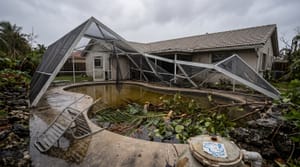
Miami-Dade sits in the High Velocity Hurricane Zone, and screen enclosures take the brunt of storm damage. You can’t storm-proof a screen cage, but you can reduce the odds of losing the entire frame.
Remove two screen panels on opposite sides of the enclosure to let wind pass through. An enclosed cage acts like a sail. A vented cage lets pressure equalize. The panels pop out with a spline roller tool (under $10 at any hardware store). Label and store the panels indoors.
Tighten any loose bolts on the frame’s connection points. Inspect the top cap and super gutter for separation. If the frame is aluminum 6005-T5 or 6061-T6 alloy rated for HVHZ, it was built to code. If it’s an older, non-rated frame, the vent approach matters even more.
Backup Power
A portable generator or battery power station keeps your sump pump running during outages. Your pool pump draws too much wattage for most portable generators, and you don’t need it during the storm anyway. Focus generator capacity on the submersible utility pump and your house essentials.
If you run a generator, keep it outdoors, at least 20 feet from windows, and never in a garage. Carbon monoxide kills more Floridians after hurricanes than the storms themselves.
The Pre-Storm Checklist
The day a storm enters the five-day forecast cone:
Test and balance your water. Shock to 10+ ppm free chlorine. Remove every loose item from the pool deck and store indoors. Wrap equipment or move it to high ground. Turn off pool breakers at the main panel. Vent two opposite screen panels. Fill the pool to the top of the tile line (the water weight holds the shell down against hydrostatic pressure from the water table). Set up your siphon hose. Confirm your submersible pump, discharge hose, and power source are accessible.
Stock all of this by May 31. The 2026 hurricane season forecast from Colorado State University calls for 13 named storms, 6 hurricanes, and 2 major hurricanes. Even a below-average season in South Florida means at least one close call.
Call Robert’s Blue Pools at (305) 762-7665 to schedule a pre-season equipment inspection and storm readiness check before June 1.