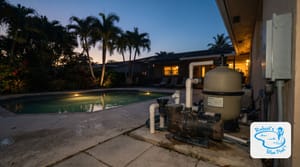
The GFCI on the pool pump trips on Tuesday. You reset it. It holds until Thursday, then trips again. The pump sounds fine and the water looks fine, so the reset button starts to feel like the repair.
It is not. Some pool problems wait for your next scheduled visit. Three do not. Here is how to tell them apart, and what to do while you wait for a technician.
A Tripping GFCI Is a Ground Fault, Not a Nuisance
A GFCI trips when current leaks somewhere it should not. NEC Article 680 governs pool wiring, and it requires GFCI protection on receptacles within 20 feet of the water. Miami-Dade enforces that article through the Florida Building Code.
A breaker that trips again and again is doing its job. Water in a pump motor, a corroded junction box or a failing light fixture can all be the path. Salt air and afternoon storms make each of those likelier here than in a dry climate.
Until the electrician arrives, switch the pump breaker off at the panel. Keep the lights off too. Do not open the equipment box or touch wet wiring yourself.
Electrical work on a pool also needs a permit in Miami-Dade, including new wiring and bonding. Swapping a pump or filter is exempt, with pool heaters the exception. Our guide to Miami-Dade pool regulations lists what needs a permit.
A Missing or Cracked Drain Cover Is a Hazard Today
The Virginia Graeme Baker Pool and Spa Safety Act requires drain covers built to the ASME/ANSI A112.19.8 standard, or its successor. The CPSC adopted ANSI/APSP/ICC-16 as that successor in 2019.
Read the scope before you quote the rule. The CPSC's guidance addresses public pools and spas, and it has applied since December 19, 2008. A public pool with a single blockable drain also needs a secondary device or system. That covers the HOA, condo and hotel pools across Miami-Dade, and it is the standard a property manager answers to.
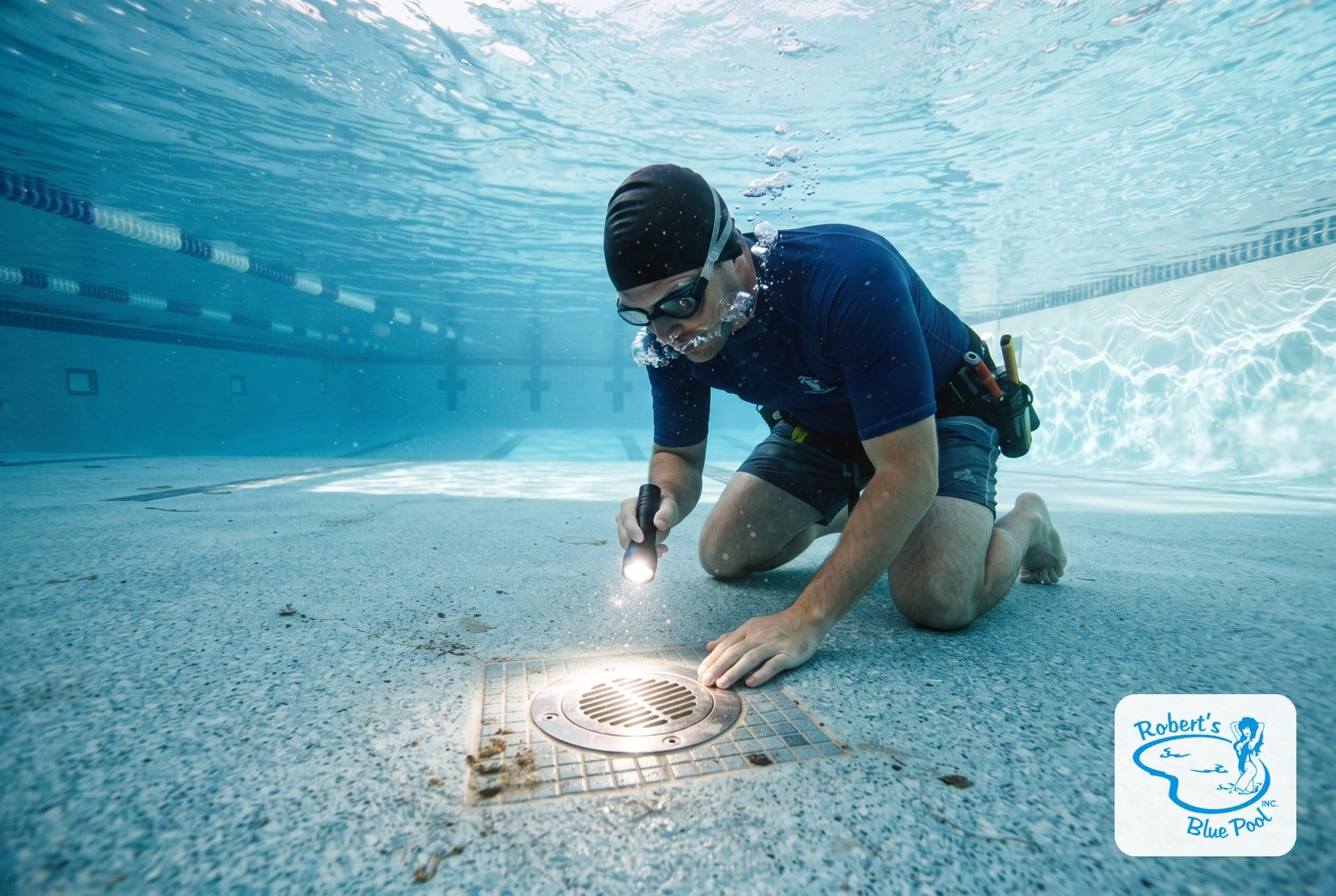
A single-family pool is not named in that guidance. The suction hazard is the same anyway. A broken, loose or missing cover on any pool means you close it. Do not run the pump to see if it holds. Replacing a cover is a job for a technician, because the right cover depends on the drain and the flow.
A Leak That Keeps Going Is Structural Until Proven Otherwise
A pool in a warm climate loses about 1/4 inch a day to evaporation. More than that is a leak. The EPA's WaterSense program estimates a leaking pool can waste more than 6,000 gallons a year, and even a minor crack can lose 2,000 to 5,000.
The urgent part is the water table. Groundwater in Miami-Dade runs high, and an empty shell can float out of the ground under hydrostatic pressure. Never drain a leaking pool yourself. Run the bucket test, write down the numbers, and let a technician choose the method. Common sources in South Florida pools are skimmer cracks, return line fittings, light niches and main drain fittings, and each needs a different test. Our post on how Miami pros find leaks you cannot see covers pressure, dye and electronic testing.
Before the technician arrives, collect three things: the date the water level first looked low, the bucket test marks after 24 hours, and a note on whether the autofill runs. Those three details save an hour of diagnosis. Take a photo of the bucket at the start and the end, so the numbers are not a memory.
What Can Wait for the Next Visit
A hairline crack narrower than 1/8 inch, too thin to catch a coin edge, is cosmetic. A shallow stain, a faded waterline tile, cloudy water and a cleaner that stopped moving can all wait for a scheduled visit. Cloudy water becomes urgent only when it turns green, because algae can bloom in 24 to 48 hours in a Miami summer.
A pump that dies in July moves up the list. Water that stops circulating in 80 to 90 degree heat turns green fast, and a severe bloom can stain plaster within days. Treat a dead pump in summer as urgent and a dead pump in January as a scheduled call.
If you cannot tell which bucket a problem falls in, our list of the five signs a pool needs repair helps you sort it.
Robert's Blue Pools has repaired Miami-Dade pools since 2007. We would rather take the call on a Tuesday for a false alarm than on a Saturday for a real one.
Is your GFCI tripping, a drain cover damaged, or your water level dropping? Call Robert's Blue Pools at (305) 762-7665 and we will tell you what can wait.