
Your pool water line dropped half an inch overnight. You filled it back up. Two days later, the same thing. The autofill valve keeps running. Your FPL bill crept up last month. Maybe it is evaporation. Or maybe your pool has a leak that is costing you hundreds of dollars a month in water, chemicals, and energy you cannot see leaving.
Most Miami-Dade pool owners wait too long to investigate. A small plumbing leak underground or a hairline crack in the shell can dump 5,000 gallons a month into the coral rock beneath your deck. At Miami-Dade Water and Sewer’s tiered rates, that pushes you into the highest billing bracket fast.
Robert’s Blue Pools has diagnosed leaks in pools across Miami-Dade since 2007. The process is more precise than most homeowners expect, and the DIY methods you read about online miss the majority of real leaks.
The Bucket Test: What It Tells You and What It Misses
The bucket test is the first step. Fill a five-gallon bucket with pool water, set it on your top step, and mark the water level inside the bucket and outside on the pool wall. Turn off the autofill valve. Run the pump. Wait 24 hours and compare the two marks.
If the pool level dropped more than the bucket level, water is leaving through something other than evaporation. In South Florida, normal evaporation runs about a quarter inch per day. Wind, humidity, and direct sun shift that number. A screened enclosure slows evaporation by blocking wind. An unscreened pool in Bal Harbour facing the ocean can lose more.
The bucket test confirms you have a problem. It does not tell you where. A pool has dozens of potential leak points: the shell surface, every return fitting, the main drain, the skimmer throat, the light niche, and hundreds of feet of underground plumbing. Guessing leads to unnecessary digging.
How Professionals Find What You Cannot See
Professional leak detection uses three methods in sequence. Each one narrows the search.
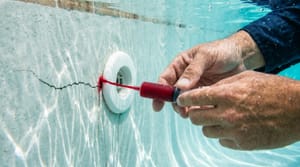
Dye testing is the most visual. A technician applies colored dye from a syringe near suspected leak points underwater: returns, drains, skimmer openings, light housings, tile cracks, expansion joints. If water pulls through a gap, the dye draws toward it. You can see the current pulling the color into the crack. Dye testing works for shell leaks and fitting leaks. It does not find underground pipe leaks.
Pressure testing handles the plumbing. A technician isolates each line, plugs it at both ends, and pressurizes it. A pressure gauge measures whether the line holds. If PSI drops, that line has a breach. This method identifies which pipe is leaking without digging a single hole. A pool with four return lines, a main drain line, a skimmer line, and a cleaner line gets tested line by line.
Electronic and acoustic detection pinpoints the exact location of an underground pipe leak. After pressure testing identifies the compromised line, a technician uses a hydrophone or acoustic amplifier to listen for the sound of pressurized water escaping through the breach. The equipment can locate a leak to within a few inches. That precision matters in Miami-Dade, where cutting into a concrete deck or drilling through coral rock costs real money per square foot.
Some technicians add thermal imaging. A FLIR camera detects temperature differences in the deck surface caused by water migrating through soil beneath the concrete. Underwater video inspection cameras check drains and pipe interiors without excavation.
Why South Florida Makes Leak Detection Harder
Miami-Dade sits on porous limestone with a water table three to six feet below the surface in many neighborhoods. That high water table creates two problems for leak detection.
First, groundwater masks leak signatures. Water moving through soil from a pipe breach sounds different when the surrounding soil is already saturated. Acoustic detection requires a technician with South Florida experience who knows how to filter groundwater noise from leak noise.
Second, hydrostatic pressure pushes up against the pool shell. If a technician needs to drain the pool for a structural repair, that upward pressure can lift the shell out of the ground. Robert’s Blue Pools uses hydrostatic relief valves and controlled partial draining to prevent pool pop, a risk that does not exist in states with deeper water tables.
The coral rock substrate adds another layer. Coral is full of natural voids and channels. Water from a leak can travel laterally through coral and surface ten feet from the actual breach. A wet spot on your deck does not mean the leak is directly below it.
What a Leak Costs When You Ignore It
A small pool leak loses 5,000 to 10,000 gallons per month. At Miami-Dade Water and Sewer rates, that adds $40 to $80 to your monthly water bill. You also lose chemicals with every gallon, so your chlorine demand climbs and your pH swings wider. The pump runs harder to maintain circulation through a system losing pressure.
Over a year, a moderate leak costs $600 to $1,200 in water and chemicals alone. That does not count the structural damage. Water migrating through soil beneath your deck undermines the base material. Deck sections settle, crack, and separate. A $300 leak repair becomes a $5,000 deck replacement if you wait two years.
Professional leak detection in South Florida runs $150 to $600 depending on the complexity. A straightforward dye test on a visible shell crack takes less than an hour. A full pressure test of all plumbing lines with acoustic location takes half a day. Either way, the detection cost pays for itself in the first month of stopped water loss.
When to Call for Leak Detection
Call for a professional inspection if you see any of these:
Your pool loses more than a quarter inch of water per day after a bucket test rules out evaporation. You notice wet spots on the deck or in the yard near the pool. Your autofill valve runs more than a few minutes per day. Your water bill increased without a change in usage. The pool loses water faster with the pump running than with it off, which points to a plumbing leak on the pressure side. You see air bubbles in the return jets, which signals a suction-side leak pulling air into the system.
Do not wait for a visible crack or a soaked yard. By that point, the leak has been running for months and the secondary damage is already accumulating.
Get It Diagnosed Before It Gets Expensive
Robert’s Blue Pools offers leak detection as part of our pool repair services across Miami-Dade County. We bring pressure testing equipment, acoustic detection, and dye testing to every inspection. Most leaks get found in a single visit. Call (305) 762-7665 to schedule a leak inspection before a small problem becomes a renovation.