Your neighbor converted to saltwater last summer and won’t stop talking about it. Softer water, fewer chemicals, no red eyes after a Saturday swim. You’re pricing out a salt chlorine generator and wondering if it’s worth the $600 to $2,200 conversion cost.
Before you commit, consider what “saltwater” means in a climate where your pool water sits above 85°F for five straight months.
Saltwater Pools Still Use Chlorine
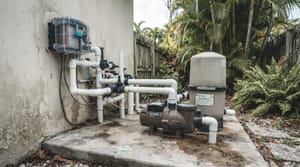
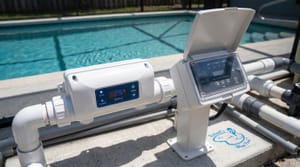
A salt chlorine generator (SCG) converts dissolved salt into chlorine through electrolysis. Your pool water holds about 3,200 parts per million of salt, roughly one-tenth the salinity of ocean water. The generator splits sodium chloride molecules, produces hypochlorous acid (the same sanitizer in chlorine tablets), and releases it into the water.
Your pool still needs chlorine. The difference is production method, not chemistry.
Many homeowners expect a saltwater conversion to eliminate chlorine management. It doesn’t. You still test free chlorine levels weekly. You still maintain cyanuric acid (CYA) at 30 to 50 ppm to shield chlorine from UV breakdown. You still shock after heavy rain or a pool party with fifteen guests.
You stop buying and handling chlorine tablets. The generator does that work for you.
How South Florida Heat Stresses the System
In cooler climates, a salt cell runs at moderate output for most of the year. In Miami-Dade, your pool water reaches 88 to 92°F in July and August and stays above 85°F from May through October.
High water temperature burns through chlorine faster. Research from Orenda Technologies on SCG conductivity shows that warmer water improves electrolysis efficiency, but the increased chlorine demand outpaces that gain. Your generator runs harder and longer to keep up.
Two problems follow.
Cell wear accelerates. A salt cell running at 100% output in 90°F water degrades faster than one running at 60% in 78°F water. Manufacturers rate cells at 8,000 to 15,000 operational hours. In South Florida, where the pump runs 10 to 12 hours daily for most of the year, you’ll hit the low end of that range. Expect cell replacement every 3 to 4 years here, not the 5 to 7 quoted in national guides.
Salt concentration fluctuates. Miami’s summer heat drives rapid evaporation, which concentrates salt in the water. Heavy afternoon rain dilutes it. You’ll check salt levels weekly during rainy season instead of the monthly schedule that works elsewhere. If your salt drops below 2,700 ppm, the generator can’t produce enough chlorine. If it rises above 3,900 ppm, you risk corrosion damage and cell overload.
If you’ve dealt with rainy season chemistry swings on a traditional chlorine pool, expect similar volatility with salt, plus one more variable to track.
The 5-Year Cost Comparison for Miami
National cost guides put saltwater and chlorine pools close to even over five years. In South Florida, the math shifts based on how you account for equipment replacement and material damage.
Chlorine pool, 5 years:
Chemicals (tabs, shock, acid, CYA) run $300 to $800 per year. Over five years: $1,500 to $4,000. No major equipment tied to the sanitizing system needs replacement.
Saltwater pool, 5 years:
Salt and chemicals cost under $100 per year ($500 total). Generator installation runs $600 to $2,200 one time. You’ll replace the cell at year 3 or 4 for $500 to $1,600. Annual electricity for the cell adds about $40 to $80 per year at FPL’s current 16 cents per kWh rate ($200 to $400 total). Five-year total: $1,800 to $4,700.
The savings gap narrows in our climate. A homeowner in North Carolina might go 6 years before replacing a cell. In Miami-Dade, you’ll replace yours at least once in that window.
Corrosion: The Hidden Cost in South Florida
Salt splash-out damages soft stone coping over time. Limestone and unsealed travertine, two of the most popular deck materials in Miami-Dade, pit and erode with constant saltwater contact. Granite and sealed concrete hold up better but cost more upfront.
Metal fixtures take the worst of it. Standard 304 stainless steel ladders, rails, and light housings corrode faster in a saltwater pool. You need marine-grade 316 stainless for anything touching the water. A set of 316 stainless rails costs $400 to $800 more than standard.
South Florida compounds this problem. Your pool equipment faces humid, salt-laden coastal air year round. A saltwater pool adds a second corrosion source. Install sacrificial zinc anodes on your ladder and rail mounts. They corrode instead of your fixtures and cost $15 to $30 to replace each year.
Plaster and pebble surfaces may need resurfacing sooner with a saltwater system, though the timeline varies by surface material and water chemistry management.
Who Benefits from Conversion
Saltwater conversion makes sense if you have a newer pool with salt-resistant coping and you want to stop handling chlorine tablets. The day-to-day convenience is real. Robert’s Blue Pools services both saltwater and traditional chlorine pools on our weekly maintenance plans, and saltwater customers spend less time thinking about chemical inventory.
Skip the conversion if your pool has soft stone coping you don’t plan to replace, standard stainless steel fixtures throughout, or a plaster surface halfway through its lifespan. The corrosion and resurfacing costs will eat your chemical savings.
The Right Generator for Miami-Dade
If you convert, oversize the generator. Pentair, Hayward, and Jandy all make units rated for 40,000-gallon pools. If your pool holds 15,000 gallons, buy the 40,000-gallon unit. Running the cell at 40 to 50% output instead of 80 to 100% extends its life by years and cuts your replacement costs over a decade.
Pentair’s IntelliChlor IC40 runs $900 to $1,200 installed. Hayward’s AquaRite S3 includes a built-in salt sensor that eliminates manual salinity testing. Both pair well with variable-speed pumps, which save $600 to $1,200 per year on your FPL bill compared to oversized single-speed models.
Robert’s Blue Pools installs and services salt chlorine generators across Miami-Dade County. Call us at (305) 762-7665 for a straight answer on whether conversion makes sense for your pool.