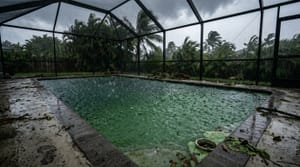
Your pool looked fine Monday morning. By Wednesday afternoon, after two days of Miami’s typical May thunderstorms, the water has a green tint. By Friday, you can’t see the bottom.
This happens to pools across Miami-Dade every rainy season. The pattern repeats from mid-May through October, and it has nothing to do with neglect. Rain changes your pool’s chemistry in three ways at once, and if you don’t adjust your maintenance schedule, algae will win.
Rain Dilutes Your Chlorine Faster Than You Think
One inch of rain falling into a standard 15,000-gallon pool adds roughly 375 gallons of unchlorinated water. Miami averages 10.5 inches of rain in June alone, according to NOAA climate data. That volume dilutes your free available chlorine (FAC) by a measurable amount after a single storm.
The CDC recommends a minimum FAC of 2.0 ppm for pools using cyanuric acid as a stabilizer. The Pool & Hot Tub Alliance (PHTA) standard ANSI/APSP-5 sets the residential target at 2.0 to 4.0 ppm. A pool sitting at 2.0 ppm before a heavy afternoon storm can drop below 1.0 ppm by the time the rain stops. At that level, algae spores already present in the water start multiplying.
If your pool service visits once a week, that leaves up to six days between treatments. In South Florida’s rainy season, six days is enough for a pool to go from clear to swamp.
Your pH Climbs, and Your Chlorine Stops Working
Rain itself is mildly acidic. But when it hits your pool and interacts with the alkalinity in the water, the net effect pushes pH upward. A pool that sat at 7.4 before a storm can read 7.8 or higher afterward.
That number matters. Chlorine exists in two forms in your water: hypochlorous acid (HOCl), which kills algae and bacteria, and hypochlorite ion (OCl⁻), which does very little. At pH 7.4, about 65% of your chlorine is in the active HOCl form. At pH 7.8, that drops below 50%. At 8.0, you’re under 30%.
Your test kit might show 2.0 ppm of free chlorine. But if your pH is 7.8, less than half of that chlorine is doing any sanitizing work. You have chlorine in the water. It’s just not doing its job.
Phosphates Feed the Algae You Can’t See
Every rainstorm washes phosphates into your pool. They come from fertilizer runoff, decaying leaves, pollen, and soil. Phosphates above 100 parts per billion give algae a food source that accelerates bloom growth.
South Florida yards are full of phosphate sources: mango trees dropping fruit, royal palms shedding fronds, St. Augustine grass treated with fertilizer. A pool in Coconut Grove surrounded by a mature tropical canopy will collect more phosphate loading per storm than a pool in a newer Doral subdivision with minimal landscaping. Either way, the phosphates accumulate through rainy season unless you test for them and treat with a phosphate remover.
The 12-Hour Window
Algae moves fast in warm water. A pool at 85°F with low chlorine and elevated phosphates can develop a visible green tint in 12 hours. In Miami’s summer, your pool water temperature sits between 84°F and 88°F from June through September. That’s ideal growing temperature for green algae (Chlorophyta), the most common type in residential pools.
You won’t see the bloom start. Algae spores are microscopic and present in every outdoor pool. They wait for conditions to line up: low sanitizer, available nutrients, warm water. A single afternoon thunderstorm can create all three conditions at once.
Adjusting Your Maintenance for Rainy Season
The same weekly maintenance schedule that keeps your pool clear from November through April won’t hold up from May through October. You need to make specific changes.
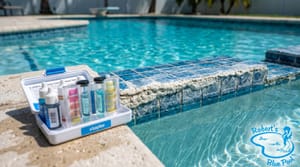
Test and adjust after every major storm. Check FAC, pH, and alkalinity within 24 hours of any rainstorm that drops more than half an inch. Don’t wait for your next scheduled service day.
Keep FAC at 3.0 to 4.0 ppm during rainy season. Running at the low end of the PHTA range leaves no margin. Target the upper end so dilution from rain doesn’t push you below the effective threshold.
Use unstabilized shock after storms. Calcium hypochlorite (cal-hypo) or liquid chlorine (sodium hypochlorite) raise FAC without adding cyanuric acid. Stabilized shock products like dichlor add CYA with every dose, and CYA above 100 ppm locks up your chlorine. In a season with 40+ inches of rain, you’ll be shocking often. Keep the CYA in the 30 to 50 ppm range and use unstabilized products to get there.
Check your stabilizer level monthly. Rain dilutes CYA along with chlorine. If your CYA drops below 30 ppm, UV from Miami’s sun will burn through your chlorine before lunch. If it climbs above 80 ppm from too much stabilized shock, your chlorine readings will look fine on paper while algae grows unchecked. The only way to lower CYA is partial drain and refill.
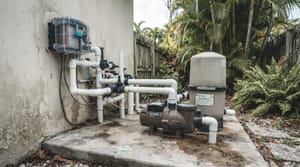
Run your pump longer. Circulation prevents dead spots where algae takes hold. During rainy season, Robert’s Blue Pools recommends running your pump 10 to 12 hours per day. If you have a variable-speed pump, the energy cost is manageable even at longer run times.
Add a phosphate remover. Lanthanum-based products from manufacturers like Natural Chemistry bind phosphates and drop them out of solution. One application after a heavy rain week can reset your phosphate level to below 100 ppb.
When Green Gets Ahead of You
If your pool is already green, standard maintenance adjustments won’t fix it. You need a full shock treatment at 10x the normal dose, followed by brushing, filtering, and backwashing over several days. A pool that’s gone dark green or black-green may need professional repair and recovery service to avoid equipment damage from running a filter system clogged with dead algae.
Robert’s Blue Pools has handled rainy season pool recovery across Miami-Dade since 2007. We adjust our clients’ chemical schedules starting in May and increase service frequency for customers who need it. If your pool turned green this week, or if you want to prevent it from happening in the first place, call us at (305) 762-7665.