A $15,000 pool renovation in Miami-Dade County sits on a property worth $575,000 or more. That ratio matters. You spend less than 3% of your home’s value, and buyers in this market notice the difference between a pool that looks maintained and one that looks tired.
The question most homeowners get stuck on: which upgrades pay for themselves at resale, and which ones are for you to enjoy while you live there? Both are valid reasons to renovate. But the numbers look different depending on what you pick.
Pool Value in the Miami-Dade Market
Redfin data from March 2026 puts the median Miami-Dade home sale price at $575,000. Single-family homes sit higher, at $674,000 to $700,000 depending on the month. Luxury sales above $1 million jumped more than 21% year-over-year.
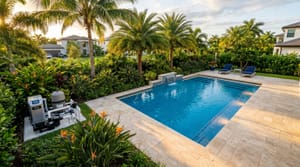
In this market, a pool is not a bonus. PoolGuard USA’s 2026 Miami statistics show 71% of all homes sold had pools. In the luxury tier, that number hits 100%. A pool is expected. A neglected pool is a liability.
The National Association of Realtors’ 2023 Remodeling Impact Report puts the average ROI for inground pool work at 56% nationally. In Sun Belt markets like South Florida, that figure climbs to 50-80% of the investment, and can push property values up 7-10%. On a $674,000 single-family home, a renovation that costs $12,000 and adds 3-5% to the sale price returns $20,000 to $34,000.
Resurfacing: the Highest-Return Renovation
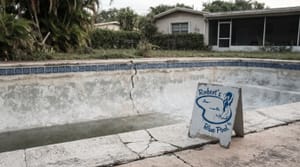
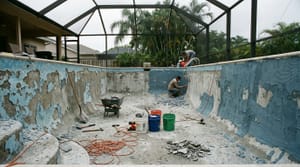
A worn, stained pool interior is the first thing a buyer’s inspector flags. Resurfacing is the single renovation with the strongest connection between cost and perceived value.
Current costs in South Florida break down by material. Plaster runs $5,500 to $10,000. Quartz aggregate, like Diamond Brite, costs $6,000 to $11,000. Pebble finishes land between $7,000 and $15,000.
The durability gap matters for ROI. Plaster lasts 7 to 10 years in South Florida’s water chemistry and sun exposure. Quartz and pebble finishes last 15 to 20 years. A buyer looking at a pool with a three-year-old pebble finish knows they have over a decade before they need to think about it again. That peace of mind translates to purchase confidence.
If your pool surface shows signs of failure like staining, roughness, or delamination, resurfacing before listing is one of the few renovations where the math tilts in your favor.
Cosmetic resurfacing over an existing shell with no plumbing or structural modifications is permit-exempt in Miami-Dade County. That saves you $3,200 to $7,500 in permit fees and weeks of approval time. Structural changes, new drains, or equipment relocation still require a building permit through the Department of Regulatory and Economic Resources.
Equipment Upgrades That Pay Back Through Energy Savings
Variable-speed pool pumps cut energy use by 50-75% compared to single-speed models. In a market where FPL bills run high and your pump operates 10 to 12 months per year, that translates to $300 to $500 per year in electricity savings. Over five years, a $1,500 pump upgrade pays for itself. Buyers with an FPL account understand this math.
The U.S. Department of Energy now requires variable-speed pumps for new installations and replacements, so upgrading before a sale puts you ahead of the regulation instead of behind it. Robert’s Blue Pools has handled pump sizing and replacement across Miami-Dade since 2007, and we see oversized single-speed pumps wasting $600 to $1,200 per year on homes throughout the county.
LED pool lighting costs $1,500 to $5,000 depending on the number of fixtures and color capability. The energy savings are modest compared to pumps, but the visual impact during evening showings is significant. A lit pool photographs well for listings, and in neighborhoods like Coconut Grove, Bal Harbour, and Key Biscayne, evening curb appeal drives offers.
Automation: Convenience That Attracts Younger Buyers
Pool automation systems from Pentair, Hayward, or Jandy run $2,000 to $4,000 installed. They let you control filtration, heating, lighting, and water features from a phone app. Programmable schedules optimize energy use and reduce the manual work of pool ownership.
Buyers under 45 expect this. They see a pool with manual valves and timers as a project. They see a pool with app-based controls as a feature. If your target buyer demographic skews younger, automation has outsized appeal relative to its cost.
The Upgrades That Are for You
Water features, custom tile work, fire bowls, and tanning ledges cost $2,000 to $16,000 or more. They make your backyard the place you want to spend Saturday. They do not, for the most part, return their cost at resale.
That does not mean they are bad investments. You live in your house. Robert’s Blue Pools works with homeowners across Miami-Dade who renovate for both reasons, and we help you understand the full renovation process so you can separate the ROI upgrades from the lifestyle upgrades and budget for each.
Timing Your Renovation
South Florida’s dry season, November through April, is the preferred renovation window. Humidity, rain, and scheduling delays during the wet season add time and cost. If you plan to list your home in early 2027, start your renovation conversation this fall.
A pool renovation in Miami-Dade, depending on scope, takes 3 to 8 weeks from permit to first swim. Resurfacing alone runs 3 to 4 weeks. Add deck work or equipment upgrades and you extend to 6 to 8 weeks.
Where the Math Lands
For a median-priced Miami-Dade single-family home at $674,000:
A $10,000 resurfacing that adds 2-3% in perceived value returns $13,500 to $20,000. A $1,500 variable-speed pump saves $400 per year and signals a maintained, efficient system. A $3,000 automation system makes the listing competitive with newer homes.
Stack those three upgrades at $14,500 total. The combined return in buyer perception and energy savings puts you ahead of what you spent, and your pool works better for you until the day you sell.
Call Robert’s Blue Pools at (305) 762-7665 to talk through which upgrades make sense for your pool and your timeline.