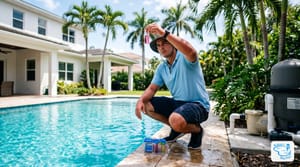
The truck has no lettering. He shows up Tuesdays, skims the leaves, drops a bag of shock in the deep end and charges less than anyone else on your street in Pinecrest. Then your pump starts screaming in August, and he offers to swap the motor that afternoon for cash.
That offer is where the savings end. Florida law draws a firm line between cleaning a pool and working on one. The chlorine brand in your shed matters far less than which side of that line your service company stands on.
Florida Lets Anyone Clean Your Pool. Equipment Work Needs a License.
Florida Statute 489.105 splits pool work in two. Skimming, brushing and dosing chemicals by hand need no license, and neither does any cleaning that leaves the pool's structure and equipment alone. Replacing a pump, adding a heater, repairing filter piping, refinishing the interior or draining the pool for a repair is the work of a swimming pool/spa servicing contractor. That work requires a state license from the Construction Industry Licensing Board.
Water treatment equipment sits on the licensed side too. The statute lets anyone run a salt system or chlorinator already bolted to your pool. Installing one, modifying it, taking it apart or replacing it takes a license. A filter cartridge swap is the one carve-out the law names.
What a License and Insurance Protect You From
A state license comes with conditions. DBPR requires Division II contractors, which includes every pool class, to carry $100,000 in liability coverage and $25,000 in property damage coverage. They must also hold workers' compensation coverage or an exemption. If a crew cracks your coping or floods the equipment room, that policy is what pays for it.
The law tilts the paperwork your way as well. Under F.S. 489.128, a contract signed by an unlicensed contractor is unenforceable by that contractor, and he gets no lien rights for the work. A pool repair contract with a licensed Division II contractor signed after July 1, 2016 can qualify for the Florida Homeowners' Construction Recovery Fund, a fund of last resort. For contracts signed on or after July 1, 2024, it caps Division II claims at $30,000. A cash deal with the guy in the unmarked truck gives you none of that.
How to Check a Pool Contractor License in Five Minutes
- Find the number. Florida requires a licensed contractor to print it on contracts, bids, ads, websites and any truck that carries the company name.
- Search it on DBPR's Verify a Licensee page by license number, company name, or license type and county.
- Confirm the status is current and the license type covers pool work. A registered license only works in the county or city that issued it. A certified license works statewide.
- Ask for a certificate of insurance that shows the liability and property damage limits.
Certified licenses renew on August 31 of every even-numbered year, and registered licenses renew in odd years, so a license can lapse between jobs. If you find someone doing licensed work without a license, DBPR takes unlicensed activity reports at 1-866-532-1440.
Reading Your Water Beats Pouring Shock on a Schedule
A license covers equipment. It says nothing about whether your technician can read water. CDC sets the home pool floor at 1 ppm free chlorine, or 2 ppm once cyanuric acid is in the water, with pH held between 7.0 and 7.8. Those numbers work against each other. As pH climbs toward 8.0, the same chlorine kills fewer germs, so a tech who pours shock on a calendar without testing pH is paying for chlorine your water can't use.
Stabilized tablets add cyanuric acid with every dose, and CDC notes that disinfection takes longer as it builds. Miami adds a problem of its own. Biscayne Aquifer fill water runs hard, and a summer of evaporation and top-offs pushes calcium up until it scales your heater and salt cell. Our post on calcium hardness in Miami pools walks through the dilution fix. A tech who tests only chlorine misses it until the scale shows.
CDC also tells owners to test chlorine and pH at least twice a day. No weekly visit can do that for you. A good service company reads the full panel on its visit and leaves you with targets you can check between visits.
Diagnostics Catch the Failure Before It Spreads
Pool equipment tends to fail in chains. A pump seal that weeps onto the pad soaks the motor bearings below it. A dirty filter drives pressure up until a clamp or a lid gives. A heater running on scaled water works harder for the same degree of heat long before it throws a code.
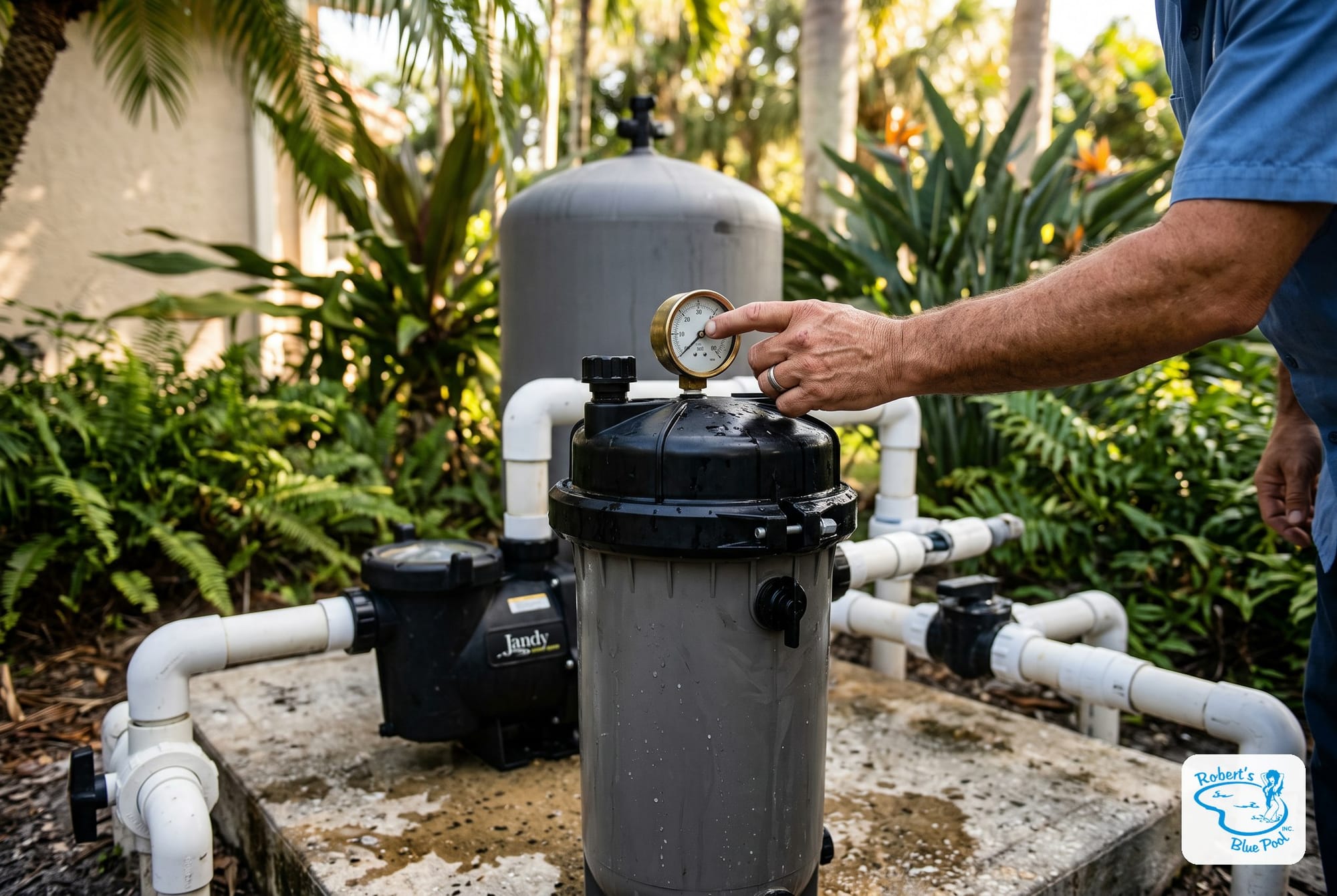
A trained technician reads the filter gauge against its clean baseline, listens to the motor and checks the pad for drips on each visit. That record is what tells you whether to repair a part or replace it, the call we lay out in when to repair vs. replace your Miami pool equipment. Switching shock brands changes nothing when nobody is reading the water or the gauge.
What to Ask Before You Hire
Ask for the license number and look it up while the person is still on the phone. Then ask what the technician tests and writes down on each visit. A company that answers both without a pause has done this for years.
Robert's Blue Pools has cared for Miami-Dade pools from Coral Gables to Key Biscayne since 2007. If you want to see how a weekly visit should run, start with our weekly pool maintenance plans.
Want a second opinion on your current service or your equipment pad? Call Robert's Blue Pools at (305) 762-7665 and we'll set up a visit.