Your Pool Doesn't Take the Summer Off
You booked the flight north. You turned down the thermostat and set the FPL account to vacation hold. But if you leave your Miami-Dade pool without a plan, you'll come back in October to green water and an equipment bill that rivals your airfare.
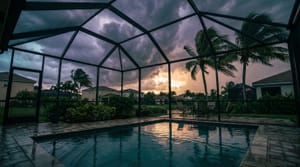
South Florida's rainy season runs May through October. Your pool will get hammered by afternoon thunderstorms, UV exposure, and heat that pushes water temperatures into the high 80s. Algae grows fast in those conditions. Equipment failures go unnoticed for months. Small problems become expensive ones.
Robert's Blue Pools has maintained snowbird pools across Miami-Dade since 2007. This checklist covers what to do before you lock the door.
Hire a Weekly Service Before You Leave
This is the single most important line item. A pool left unattended from May to October in South Florida will develop algae within two weeks. Your service company needs to check chemical levels every seven to ten days during summer. Someone has to clear the skimmer baskets, brush the walls, and backwash the filter.
If you don't have a weekly maintenance plan in place, set one up before you go. Give your service company a spare key or gate code. Leave your phone number for emergencies.
Set Your Pump Schedule for Summer
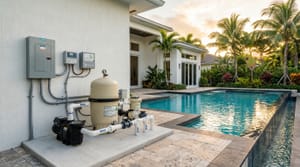
FPL recommends running your pool pump six hours per day during summer months. That keeps water circulating enough to distribute chlorine and prevent stagnation. If you have a variable-speed pump, run it at a lower RPM for eight hours instead of a higher RPM for four. You'll get better filtration and use less electricity.
FPL offers a $300 rebate on ENERGY STAR certified variable-speed pumps, which use about 70% less energy than single-speed models. That saves about $460 per year on your electric bill. If your pump is older than eight years and single-speed, replacing it before you leave pays for itself in two summers.
Use Automation If You Have It
Pentair's IntelliCenter has a vacation mode that lets you set start and stop dates. The system runs a daily filter schedule you define, then reverts to your normal settings when you return. Previous vacation schedules stay saved in memory, so you can reuse them next year.
Pentair's ScreenLogic 2 and Hayward's AquaConnect both let you monitor and adjust your pool from a phone app. If a storm knocks out your pump timer, you'll know about it from 1,200 miles away instead of discovering it three months later.
Balance the Water and Shock It
The week before you leave, test and adjust your water chemistry to these targets:
- Free chlorine: 3-5 ppm (on the higher end gives your service tech a buffer)
- pH: 7.4-7.6
- Alkalinity: 80-120 ppm
- Calcium hardness: 200-400 ppm
Miami-Dade tap water runs high in calcium hardness. If your calcium is already above 400 ppm, tell your pool service. Scaling builds up faster on unattended pools because nobody is catching it week to week.
Shock the pool 24 to 48 hours before departure. Use calcium hypochlorite or liquid chlorine at shock dose. That spike in sanitizer kills anything brewing and gives your service company a clean baseline for their first visit.
Manage the Water Level
Summer in South Florida means rain. A lot of it. Miami-Dade averages over 60 inches of rainfall per year, and most of that falls between June and September. Your pool water level will rise after storms.
Before you leave, set the water level to the middle of your skimmer opening. That gives room for rain to raise it without flooding the deck, and room for dry stretches to lower it without starving the pump. Your service tech should adjust the level as needed, but starting at the midpoint helps.
Do not drain the pool. An empty pool in South Florida's high water table can crack or pop out of the ground from hydrostatic pressure. If you need to lower the water for a specific repair, your pool company should handle that.
Protect Your Equipment from Storms
Hurricane season starts June 1. If you've already installed surge protection on your pool equipment, confirm the devices are rated and functional before you go. If you haven't, a whole-home surge protector plus a point-of-use SPD on the pool subpanel costs $300 to $700 installed and protects pumps, heaters, salt cells, and automation controllers from lightning strikes.
Ask your service company to turn off the pump and equipment at the breaker if a named storm is approaching. Most will do this as part of their hurricane preparation protocol. Make sure they know how to reach you if equipment sustains damage.
Check Your Safety Barriers
Florida's Residential Swimming Pool Safety Act (Chapter 515, Florida Statutes) requires at least one approved safety feature on all residential pools. Your pool needs a barrier enclosure, a safety cover meeting ASTM F1346-91, exit alarms rated at 85 decibels at 10 feet, self-closing doors with latches at 54 inches or higher, or a pool water alarm.
Before you leave, verify your chosen safety feature works. Test alarm batteries. Inspect screen enclosure panels for tears or loose frames. A pool left unsupervised for five months needs its safety barriers in good shape. If your screen enclosure took damage during last year's storms, get it repaired before you go.
Shut Down What You Don't Need
Turn off pool heaters and heat pumps. You won't need them, and leaving a heater running on an unattended pool wastes hundreds of dollars per month in electricity.
Turn off water features. Fountains and spillovers increase evaporation and chemical consumption. Your service tech doesn't need them running to maintain the pool.
Leave the pool light off. If your light fixture has a crack or seal failure, running it while you're gone risks a short circuit. LED lights draw little power, but there's no reason to light an empty backyard.
Leave a File for Your Service Company
Print or email a one-page sheet with:
- Your contact info and emergency phone number
- Dates you'll be away and your expected return
- Gate code or key location
- Equipment specifics: pump model, filter type, salt cell brand if applicable
- Any known issues (slow leak, finicky heater valve, screen door that sticks)
The more your tech knows, the fewer surprises you both face in October.
One Last Walk-Around
The day before you leave, walk the pool deck. Look for cracked tiles, loose coping, standing water near the equipment pad, and anything that could become a bigger problem after five months of sun and rain. Take photos of the pool surface, equipment, and deck. You'll want a before-and-after comparison when you return.
Robert's Blue Pools maintains snowbird pools across Bal Harbour, Key Biscayne, Coconut Grove, Coral Gables, and throughout Miami-Dade County. Call (305) 762-7665 to set up summer maintenance before you head north.