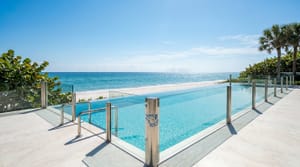
A pump motor on an oceanfront Bal Harbour lot does not die from age. It dies from salt. Park a stainless rail, a heater cabinet, or a motor housing two blocks from the Atlantic and the air does in a few years what would take a decade inland. Robert’s Blue Pools has serviced pools across this barrier-island village since 2007, and the pattern holds on almost every street. Equipment here corrodes faster, surfaces stain sooner, and the repairs cost more when owners wait.
Bal Harbour sits on a narrow strip between the ocean and Biscayne Bay. Salt spray rides the breeze inland and settles on everything. Your pool gets the same exposure your car and windows do, with one difference: your pool equipment runs wet, warm, and electrified ten to twelve months a year.
Why salt air goes after your equipment first
Fine salt grains land on motor housings, bolt heads, electrical terminals, and the seams of your heater cabinet. Our humidity gives them the moisture they need to form a film that pulls current and eats metal. Pump motors lose their bearings, heater cabinets rust from the base up, and light niches corrode at the screw terminals until a connection fails.
Stainless steel does not save you on its own. Chloride ions attack the protective layer on stainless and start pitting that hides under the surface until a ladder bolt or a fastener snaps. Builders often spec grade-304 stainless, which holds up inland but loses to coastal air. Marine-grade 316 stainless costs more and lasts longer within a few hundred feet of the water, which covers most of Bal Harbour.
The heater is the expensive casualty
Salt air and hard water both attack the heat exchanger, the most expensive part inside a gas heater. If you run a heater here, the exchanger metal decides how long it lasts. Hayward and Pentair both build cupro-nickel exchangers, found in the Hayward H-Series and the Pentair MasterTemp, that resist corrosion better than standard copper. If you heat with a heat pump instead, look for a titanium exchanger, which AquaCal and other manufacturers use for the same reason. Spend on the right metal up front and you skip a heater replacement three summers early.
Bonding and anodes: the defense most pools skip
Salty water conducts electricity better than fresh water, and that conductivity speeds up galvanic corrosion, the slow electrical eating-away of metal parts wired into the same system. The National Electrical Code plans for this. NEC Section 680.26(C) requires a corrosion-resistant conductive surface of at least nine square inches in contact with the pool water, tied into the bonding grid. That bond protects swimmers and metal alike.
A sacrificial zinc anode adds a second layer. The anode wires into your bonding circuit and corrodes in place of your heater, rails, and light rings. Zinc gives itself up so the parts you paid for survive. A typical anode lasts about three years before it dissolves and needs replacing. On a Bal Harbour pool, a $40 anode and an annual bonding check buy you years on equipment that runs into the thousands. We build both into our weekly maintenance plans so nothing slips between visits.
Surfaces, water, and the coastal stain problem
Salt and minerals also work on the inside of your pool. The coastal water table pushes hard, mineral-heavy water into the supply, and that water leaves scale at the waterline. When corroding fixtures bleed copper and iron, you get metal staining on the walls and floor. Plaster on a coastal pool shows wear and staining sooner than the same finish inland. A quartz or pebble finish stands up better to the chemistry here, which is why we steer Bal Harbour owners toward those finishes when it is time to resurface.
Rinsing helps more than people expect. A freshwater hose-down of your equipment pad every couple of weeks washes the settled salt off before it sits and corrodes. It costs nothing and adds years to every motor and cabinet on the pad.
The flood factor on a barrier island
Bal Harbour is a designated floodplain. The Village defines a 100-year flood as ten or more inches of rain in 24 hours, with a one percent chance in any given year. When that water rises, it carries salt and debris into your pool and over your equipment pad. After any flood event, your equipment needs an inspection for water intrusion, your bonding needs a check, and your water needs a full rebalance. Equipment that sat in brackish floodwater can fail weeks later from corrosion that started the day it went under.
What this means for your pool
A pool in Bal Harbour needs a maintenance approach built for the coast. That means marine-grade hardware, the right heat exchanger metal, a working anode and bond, a coastal-friendly finish, and a fresh rinse on the equipment more often than an inland pool would ever need. Robert’s Blue Pools has run this playbook on Bal Harbour pools for years, and it is why our coastal pools get ten years out of a pump instead of four. Our Bal Harbour service team knows these streets and the salt that comes with them.
Call Robert’s Blue Pools at (305) 762-7665 for a coastal pool assessment and we will show you exactly where the salt is winning.