Your pool tech calls in sick on a Tuesday afternoon. You go out back and notice the water level dropped two inches overnight, and there's a wet patch forming under the equipment pad. Call someone right now, or put it on the list for next week?
The answer depends on what's actually wrong. Not every pool problem is an emergency. But a few specific ones are, and waiting on the wrong one can turn a repair job into a renovation.
What Counts as an Emergency
Electrical Problems
Any sign of electrical trouble around a pool demands same-day action. If your GFCI trips and resets and trips again, that's not a nuisance. That's the circuit doing its job. Other symptoms that require a same-day call: a tingling or mild shock when touching a pool ladder or handrail, a pump that runs but repeatedly trips the breaker, or pool lights flickering without explanation.
The National Electrical Code Article 680 governs pool wiring, and Miami-Dade County enforces it through the Florida Building Code. All receptacles within 20 feet of the pool require GFCI protection. Pool lights operate at low voltage, but even low-voltage systems fail in ways that create shock hazards at the water surface. The CPSC tracks pool electrocution deaths each year, and nearly all involve situations that began with a small electrical issue someone delayed addressing.
Shut off the circuit at the panel and call a licensed electrical contractor before anyone gets back in the water. Do not test by getting in the pool yourself.
Broken or Missing Drain Covers
Walk the bottom of your pool. If a drain cover is cracked, dislodged, or missing, that's an emergency — not a cosmetic issue, not something to schedule for next month.
The Virginia Graeme Baker Pool and Spa Safety Act, which took effect December 19, 2008, requires all pools to have drain covers meeting ASME/ANSI standard A112.19.8. The law exists because a compromised single-drain system can generate suction strong enough to trap a child underwater. After the VGB Act took effect, the CPSC documented a full decade with zero drain entrapment-related child deaths in public pools. A working drain cover does that.
A cracked cover or a non-compliant substitute needs replacement before anyone swims. A compliant drain cover costs $100 to $250 installed. Schedule it today.
An Active Structural Leak
A pool losing more than 1/4 inch of water per day beyond normal evaporation has a leak. To separate evaporation from a real leak, run the bucket test: fill a bucket to pool water level, set it on a step with both bucket and pool exposed to the same sun and wind, and check after 24 hours. If the pool dropped more than the bucket, you have a leak.
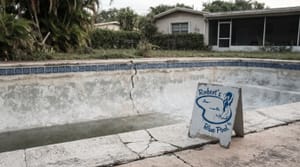
The reason to act fast in Miami-Dade specifically: the water table sits high, particularly in coastal areas and along the limestone shelf underlying most of the county. A pool leaking into soil already near saturation accelerates erosion under the pool shell and deck. What presents as a plumbing leak can destabilize a deck in weeks. And draining the pool without professional guidance creates its own problem: hydrostatic pressure from the water table can physically lift an empty pool shell out of the ground.
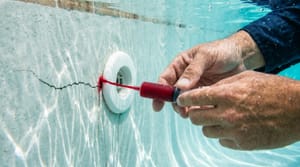
Professional pool leak detection in Miami-Dade runs $325 to $600 for a residential pool. A pressure test pinpoints whether the leak is in the shell, the plumbing lines, or fittings like the skimmer or light niche. That test costs far less than the deck repair that follows if you wait.
Total Equipment Failure in Summer
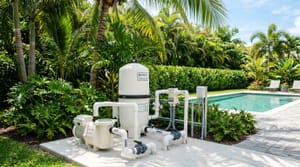
If your pump stops running entirely between May and October, you have roughly 24 to 48 hours before pool chemistry starts to collapse. Without circulation, chlorine dissipates, pH drifts, and the water temperature in a South Florida backyard climbs fast. Algae blooms in stagnant warm water, and a severe bloom can stain plaster in days.
Not every equipment problem rises to this level. A tripped breaker from a thunderstorm is not the same as a failed motor. But if your pump won't run and you can't identify a simple cause — tripped breaker, clogged basket, air lock after a power outage — call your pool company and describe the pump as completely down. Get an assessment within 24 hours.
What Can Wait
Surface Staining
Rust staining from corroded ladder bolts, copper staining from low pH interacting with metal fittings, organic staining from leaves — none of these are emergencies. Staining is cosmetic. Treat it at your next scheduled service visit.
Copper staining is common in South Florida. Miami-Dade tap water is moderately hard, and year-round heat accelerates the reactions that pull copper out of heater heat exchangers and into the water. If you see blue-green staining near fittings, your service tech can address it without a special trip.
Hairline Surface Cracks
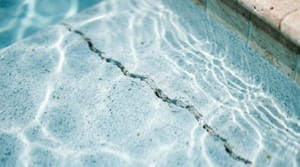
A crack you can see but can't fit the edge of a coin into is a surface crack in the plaster or finish, not a structural crack through the gunite shell. Surface cracks are common in aging plaster and are a maintenance issue, not a repair emergency. Note it, monitor it, and address it when the pool is next due for resurfacing. Our guide on how often to resurface a South Florida pool covers what to watch for.
Cracks worth calling about right away: any crack that has grown since you first noticed it, cracks that feel sharp and deep, or cracks accompanied by measurable water loss.
Cloudy Water
Cloudy water is almost always a chemistry problem: low chlorine, high pH, or a filtration issue. Unless the pool is completely opaque and you have guests swimming today, this is a chemical adjustment. Run the pump on a longer cycle, test your chlorine and pH, and let your service company address it at the next scheduled visit. The Miami-Dade pool regulations guide covers water quality standards if you want to understand what the county considers safe for swimming.
Automatic Cleaner Problems
If your Polaris stopped moving or your suction cleaner lost pressure, put it on the list for the next service visit. Cleaner problems don't affect water quality or safety. The pool just gets some leaves on the bottom until someone looks at it.
When You're Not Sure
If you can see a problem but can't tell whether it needs immediate attention, call Robert's Blue Pools at (305) 762-7665. Describe what you see, and we'll tell you on the phone whether it needs same-day service or can wait for a scheduled visit. A two-minute call is free, and it can save you from making the wrong call in either direction.
Most of the pool emergencies we respond to in Miami-Dade could have been caught a visit earlier. If you're not on a regular maintenance schedule, that's the right place to start.