
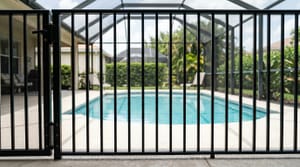
A four-year-old can reach the pool in under 30 seconds. The CDC reports that more children ages 1 to 4 die from drowning than from any other cause. In Florida, where pools stay open year-round and backyards connect to water through sliding glass doors, that statistic hits close to home.
Florida Statute §515.27 exists because of those numbers. It requires every new residential swimming pool to include at least one approved safety feature before the county issues a certificate of completion. If you skip it, you face a second-degree misdemeanor. The law has teeth, and Miami-Dade County enforces it.
What the Law Requires
Under the Florida Residential Swimming Pool Safety Act, every new pool must have at least one of these five safety features:
A barrier enclosure that meets the specifications in §515.29. This is the most common choice. The barrier must stand at least 48 inches tall on the outside, with no more than a 2-inch gap between the bottom edge and the ground. No gaps, handholds, or structural features that let a small child crawl under, squeeze through, or climb over. The barrier must surround the pool perimeter and be separate from your yard fence unless that fence meets the same standards.
An approved safety pool cover rated to support the weight of a child who walks onto it.
Exit alarms on every door and window that opens directly to the pool area. Each alarm must produce at least 85 decibels at 10 feet, which is roughly the volume of a kitchen blender. The deactivation switch must sit at least 54 inches above the threshold, out of a child's reach. You can wire sensors to a central alarm system instead of installing individual units on each door.
Self-closing, self-latching doors on every entry to the pool area. The latch release mechanism must sit no lower than 54 inches from the floor.
A pool alarm certified to ASTM Standard F2208. These detect unauthorized entry into the water using surface motion sensors, pressure sensors, sonar, laser, or infrared technology. A wearable alarm on a child's wrist does not satisfy this requirement.
You need at least one. Robert's Blue Pools recommends combining two or more, especially if you have young children or grandchildren visiting.
Miami-Dade Goes Further
Miami-Dade County Code Section 33-12 adds its own layer of requirements on top of the state statute. The county's Office of Building Code Compliance reviews pool barriers during inspections and has published specific guidance on materials, gate hardware, and fence construction.
If you use chain-link fencing as a pool barrier, Miami-Dade requires a building permit for the fence itself. Wood and aluminum fences used as pool barriers also trigger permit review under the county's residential standards.
The practical takeaway: your pool contractor and fence installer both need to know that Miami-Dade operates under a High-Velocity Hurricane Zone building code. A barrier that passes inspection in Orlando may not pass here. The materials, fasteners, and engineering calculations differ.
Common Mistakes That Fail Inspection
Pool barriers in Miami-Dade fail inspection for predictable reasons. Horizontal rails spaced too closely together create a ladder effect. Gates that don't self-close or self-latch draw immediate flags. Landscaping features like raised planters or decorative boulders near the fence line give children a climbing surface.
Screen enclosures count as barriers only if they meet the 48-inch height requirement and the screen panels cannot be pushed through. A standard pool cage with an unlatched door does not satisfy the law. The door must self-close and self-latch.
Another frequent issue: the gap between the barrier and your home. If your house wall forms one side of the pool enclosure, every door and window on that wall needs alarms or self-closing hardware. Homeowners often miss second-story windows that open onto a balcony with pool access below.
What Changes When You Sell
Florida Senate Bill 244, filed in the 2026 legislative session, addresses pool safety requirements for residential properties that change hands. If you sell a home with a pool after July 1, 2026, the pool safety barriers and features may face additional scrutiny during the transaction.
Sellers should verify that their existing safety features still function and meet current code. A door alarm that worked when the pool was built in 2012 may have dead batteries or a broken sensor today. Self-closing hinges corrode in South Florida's salt air. Springs lose tension. Gates sag.
Robert's Blue Pools includes a safety feature check as part of our weekly maintenance plans. We test gate latches, check alarm batteries, and inspect barrier integrity during routine visits. It costs nothing extra, and it keeps you in compliance year-round.
The Numbers Behind the Law
The CPSC reports an average of 358 fatal drownings per year in pools and spas across the United States, based on 2019 through 2021 data. Seventy-five percent of those victims were younger than five. The CDC puts the broader number at roughly 4,000 unintentional drowning deaths per year nationwide, or about 11 per day.
Florida has ranked among the top states for child drowning deaths for years. The combination of warm weather, a long pool season, and a high number of residential pools per capita creates conditions that other states don't face. In Miami-Dade, pools stay uncovered and accessible 365 days a year. There is no off-season for drowning risk.
Barriers work. A four-sided isolation fence around a pool reduces the risk of drowning in children under five by more than half, according to CDC research. The fence does not eliminate risk. Supervision remains the first and most important layer. But the fence buys time when a parent turns away for 30 seconds to answer the phone or check on another child.
What to Do Right Now
Walk your pool perimeter this week. Check every gate latch, every hinge, every alarm battery. Measure the barrier height from the outside. Look for new landscaping, furniture, or toys that could serve as a stepping surface.
If your pool predates the current code and you have never added a safety feature, you are not grandfathered out of responsibility. The statute applies to new pools, but Miami-Dade code enforcement can cite barrier deficiencies on any residential pool during a complaint investigation.
Call Robert's Blue Pools at (305) 762-7665 for a safety barrier inspection before summer gets into full swing.