
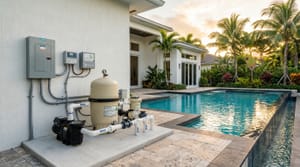
A single lightning strike can fry your pool pump's control board in a fraction of a second. Florida sees 1.2 million cloud-to-ground lightning flashes per year, according to Florida State University's Emergency Management division. South Florida sits in one of the densest lightning corridors in the country. Your pool equipment sits outside, wired into your home's electrical system, exposed to all of it.
Replacing a variable-speed pump runs $1,500 to $2,500 for the unit alone. Add a fried automation panel or heater circuit board and you're looking at $3,000 to $8,000 in repairs. A surge protector costs $150 to $300 installed. The math is not complicated.
How Power Surges Damage Pool Equipment
Lightning doesn't have to hit your property to cause damage. A strike within a mile can send a voltage spike through FPL's power lines and into your pool equipment panel. The spike travels through the wiring and hits the most sensitive components first: the microprocessors in your variable-speed pump and the circuit boards in your salt chlorine generator.
Older single-speed pumps with simple induction motors could absorb minor surges without failing. Modern variable-speed pumps from Pentair, Hayward, and Jandy run on electronic inverter drives. These drives save you 60 to 80 percent on energy costs, but they contain circuit boards that a 1,000-volt spike will destroy.
FPL grid instability during storms creates a second problem. Rapid on-off power cycling, where the power drops and returns several times in a few minutes, stresses pump motors and corrupts automation system memory. You come outside after the storm passes and your Pentair IntelliTouch has lost its programming, your pump won't start, or your heater throws error codes.
What a Surge Protector Does
A surge protective device (SPD) sits in your electrical panel and absorbs excess voltage before it reaches your equipment. When a spike hits the line, the SPD diverts the energy to ground. Your pump and automation system see normal voltage.
Two types matter for pool owners:
Type 2 SPD at your main panel. The 2023 National Electrical Code, Section 230.67, now requires a Type 1 or Type 2 SPD on all dwelling unit electrical services. Florida adopted this code. If your home's electrical panel was installed or upgraded in the last few years, you may have one. If your home was built before 2020, you don't. A Type 2 SPD at the main panel protects your whole house, including the circuit feeding your pool equipment.
Dedicated SPD at the pool equipment subpanel. This is the one Robert's Blue Pools recommends for every customer. Even if your main panel has surge protection, a dedicated SPD at the pool subpanel catches surges closer to the equipment. The Intermatic PS3000 is built for pool and spa applications. For Pentair automation systems, the Pentair AI201 surge suppressor connects to 230V transformer wiring on IntelliTouch and EasyTouch panels.
Where to Install and What It Costs
Your licensed electrician mounts the SPD inside the pool equipment subpanel and wires it to two breaker positions. The closer the SPD sits to the equipment's feed connections, the better it performs. Installation takes about an hour.
Expect to pay $150 to $300 for the device and installation combined. The Intermatic PS3000 retails around $80 to $120. The Pentair AI201 runs about $60 to $90. Labor adds $75 to $150 depending on your electrician and panel accessibility.
Miami-Dade County requires an electrical permit for any pool electrical work, including SPD installation. Your electrician should pull this permit. Don't skip it. Unpermitted electrical work can void your homeowner's insurance coverage for surge damage, which defeats the purpose of installing protection in the first place.
Beyond the SPD: A Full Surge Protection Plan
An SPD handles voltage spikes. It won't protect against flooding, wind-driven debris, or extended power outages. Before June 1, take these steps:
Install the SPD now. April and May are the window. Licensed electricians in Miami-Dade get booked solid once the first tropical storm forms. Schedule installation before the rush.
Check your equipment bonding. NEC Article 680 requires all pool equipment, water, and metal components to be bonded together. Proper bonding gives surge energy a clear path to ground instead of through your pump motor. If your pool was built before current code, a bonding inspection during your next maintenance visit is worth the time.
Program your automation system's storm mode. Pentair and Hayward systems include settings that shut down equipment when power fluctuates. Enable these before storm season. If you don't have automation, install a timer override so your pump doesn't restart on its own after a power outage. You want to inspect the equipment pad before anything kicks back on.
Document your equipment for insurance. Photograph every piece of pool equipment with serial numbers visible. Save receipts for the SPD and installation. If lightning does cause damage, your adjuster needs this documentation. The average lightning insurance claim runs over $6,000, according to industry data from the Insurance Information Institute.
When Surge Protection Won't Save You
A direct lightning strike to your pool equipment pad can overwhelm any residential SPD. No $200 device stops a 300-million-volt bolt at point of contact. SPDs protect against indirect surges traveling through the power grid, which account for the vast majority of storm-related equipment damage in South Florida.
SPDs also degrade over time. Each surge they absorb reduces their capacity. The Intermatic PS3000 includes an LED indicator that turns red when the device needs replacement. Check it once a year. Robert's Blue Pools checks SPD status during routine equipment inspections for our maintenance customers.
Storm season starts June 1. A $200 surge protector installed this month can save you thousands in equipment replacement costs this summer. Call Robert's Blue Pools at (305) 762-7665 to schedule your pre-season equipment inspection and SPD installation.